#1 Slab Leak Repair Flagstaff, AZ
Already in Flagstaff — warm spot on your tile? Acoustic and thermal pinpointing finds the break, then repair or reroute. Call (866) 471-4088 — 24/7.
Live dispatcher 24/7 · Upfront flat-rate price before any work · Serving 86001, 86004, 86005, 86011
Slab Leaks in Flagstaff Are Not Phoenix Slab Leaks
Most Arizona slab-leak content is written for the desert — hard water, shifting caliche, attic-hot copper. Flagstaff’s slabs fail for different reasons, and that is exactly why slab leak repair in Flagstaff, AZ looks different from the repair you would get 142 miles south. At roughly 6,900 feet of elevation, with about 109 inches of snow a year and ground that swings from basalt to cinder to ash across a single lot, this city’s concrete slabs sit on the most restless ground in our entire Arizona network. Freeze-thaw cycles push and settle the soil under your foundation season after season; volcanic fill and cinder layers shift at a different rate than the slab; and copper or galvanized lines buried in that concrete get flexed like wire in a paperclip. A pipe that survived its first twenty years can open a pinhole in its twenty-fifth — and because the leak is under the slab, the first sign is often your water bill, not water. If you need the pinpointing work explained first, start with our leak detection page — acoustic and thermal tools that find the break within inches before anyone talks about repair. This page is the repair half: what your options are, what each one costs, and which one your slab actually needs.
Here is the Flagstaff-specific reality that Phoenix pages never tell you: the damage often does not show in January. It shows at the thaw. A supply line stressed by freeze-thaw movement all winter can weep slowly for months under the slab, invisible, and only flood when the ground warms, the ice blockages melt, and full pressure returns in March. “Your slab survived January; March is when it floods” is the pattern we see year after year. That matters for timing — a suspicious bill in February is worth investigating before the thaw — and it matters for repair choice, because a line that froze and flexed is a line you may not want to simply patch in place. A burst pipe inside the wall is a crisis; a slab leak is the slow-motion version of the same failure, and in a freeze-first market like Flagstaff it deserves the same urgency. If the heater is the casualty instead of the slab, our water heater repair page covers the altitude and winter angle.
Flagstaff’s housing stock tells you which pipes are under your slab. The downtown core and the Railroad Addition still hold 1890s–1900s homes — many of them on crawlspaces or basements rather than slabs, so the slab-leak conversation starts with the 1960s–1990s tract era. Southside and North End bungalows (1930s–50s), Sunnyside ranch homes (1940s–60s), and the big 1970s–90s ranch-style subdivisions are where slab-on-grade dominates — and the city’s own EPA service-line inventory, which found unknown-material service lines still in the ground and mailed notices to customers in November 2024, confirms that galvanized-era plumbing is real Flagstaff infrastructure, not ancient history. Galvanized lines were commonly used in that mid-century era, and under a slab that has been frost-heaved for fifty winters, “commonly used” is all the warning you need. One call to (866) 471-4088 reaches a dispatcher who knows the difference between a Southside slab and a Doney Park septic setup — 24/7, with the price in writing before any work starts.
Suspect a slab leak right now?
Warm tile, running-water sounds, a bill climbing for no reason — describe the symptom, get a straight answer.
Call — (866) 471-4088The 6 Signs of a Slab Leak in Flagstaff
Slab leaks announce themselves quietly. Any one of these is worth a call — two or more together is a slab leak until proven otherwise.
A warm spot on the floor
The single most common sign: a patch of tile or concrete that feels warm when nothing else does. Hot-water lines under the slab leak first, and heat rises straight through. In winter, people dismiss it as heating — do not.
Water sounds with everything off
Hearing water run when no faucet, toilet, or appliance is on means water is moving where it should not. Press your ear to the slab in the quiet hours — a slab leak hisses.
A bill climbing for no reason
Flagstaff’s metered water does not lie. If the bill rises month after month with no new occupants or habits, run the meter test: everything off for 15–20 minutes, and if the meter moves, water is going somewhere underground.
Damp baseboards or musty smells
Moisture wicks up through the slab edge and into walls. Baseboards that swell, paint that bubbles, or a musty smell in one room are the visible half of an invisible leak.
Cracks in tile or concrete
A leaking line erodes the soil under the slab — especially cinder and ash layers, which wash out fast. The slab settles unevenly, and cracks follow. A crack plus any sign above is the full picture.
Low water pressure or hot-water delays
A leak is a second demand the system never asked for. Pressure drops, and hot water takes longer to arrive because part of it is going into the ground, not your faucet.
Two or more of these?
That is a slab leak until proven otherwise — and a meter test takes 20 minutes.
Call — (866) 471-4088Why Flagstaff Slabs Fail Differently
The San Francisco Volcanic Field is not scenery — it is what your foundation sits on. And winter is not just weather — it is a slow jackhammer under your slab.
Volcanic soil under concrete
Flagstaff sits in the San Francisco Volcanic Field — roughly 600 volcanoes’ worth of basalt lava flows, cinder cones, and volcanic ash layered over Kaibab limestone. In practical terms: your slab may sit on dense basalt in one corner and loose cinder in the other. Cinder and ash compact and wash out under a leak; basalt barely moves but transmits every stress. Freeze-thaw adds a yearly cycle of ground expansion and contraction that flexes the slab — and the copper or galvanized supply lines embedded in it — season after season. We will not quote you a frost-line depth number, because Flagstaff’s official figure is not published and a neighboring county’s 30-inch standard is not Flagstaff’s rule. What matters is the mechanism: ground moves, slab flexes, pipe fatigues, pinhole opens.
What this means for the repair
Volcanic ground changes the math on every repair option. Jackhammering a slab that sits on basalt is a different job than jackhammering one on cinder — rock excavation is slow and it moves the quote. That is one reason the overhead reroute (abandoning the failed line and running new pipe through the attic) is so popular in Flagstaff: it skips the digging entirely. And because excavation here can hit basalt, trenchless thinking applies beyond the sewer line world — the less you disturb volcanic ground, the fewer surprises. Before any digging happens, Arizona 811 (Blue Stake) marks utilities — in rock, a utility strike is a costly day.
Not sure what is under your slab?
Tell us your neighborhood and build year — we will tell you what that ground usually means for the repair.
Ask a Plumber — (866) 471-4088The Thaw Flood: “Your Slab Survived January”
Here is the freeze-first-market pattern nobody in Phoenix content understands: the damage does not show at the freeze. It shows at the thaw.
Freeze is the injury; thaw is the symptom
When a cold snap locks the ground, an ice blockage can form in or around a supply line. Pressure builds behind it; the pipe flexes or pinholes; but the frozen ground itself can mask the leak — ice seals the break, frozen soil does not let water travel. The homeowner in 86004 hears nothing, sees nothing, and the February bill looks almost normal. Then March arrives. Snowmelt soaks the ground, the ice blockages melt, full water pressure returns to a line that has been compromised since December, and the leak announces itself all at once: warm tile, hissing slab, a bill that jumps. That is the thaw flood — and it is why “we made it through winter” is the most dangerous sentence in Flagstaff plumbing.
What to do before the thaw
If your winter bill crept up, or you heard faint running-water sounds in January and talked yourself out of it, February is the time to act — not April. A meter test now catches the slow weep before it becomes the spring flood. Seasonal residents get hit hardest: a Pine Canyon second home closed up in November, heat set low or off, opens in May to months of hidden damage. The Pine Canyon winterization playbook (main shut off, lines blown out with compressed air, RV antifreeze in traps, heat at minimum 55°F) exists precisely because thaw damage is the local tax on an unprepared shutdown. Winterization questions belong with the freeze experts — and freeze-driven burst pipe repair is the same physics in a different pipe.
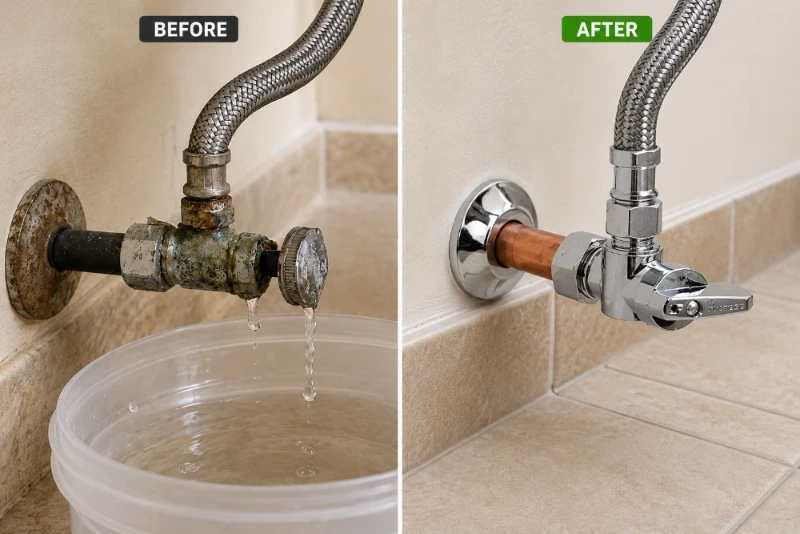
A failed copper supply line before and after professional repair — the kind of pinhole freeze-thaw and soil movement open under Flagstaff slabs.
February bill creeping up?
Do not wait for the March flood. A meter test and acoustic check now is the cheap version of this job.
Call — (866) 471-4088Flagstaff Housing Eras — What’s Under Your Slab
Tell us the decade, and we can usually tell you the pipe. The table below shows what is typical for the era — not a guarantee for any specific house, because remodels and repairs rewrite the story.
| Era | Where in Flagstaff | Typical supply pipe | Slab-leak risk note |
|---|---|---|---|
| 1890s–1900s | Downtown, Railroad Addition | Galvanized (later replacements) | Many on crawlspaces/basements — slab leaks rare; pipe corrosion is the issue |
| 1930s–1950s | Southside, North End bungalows | Galvanized — common for the era | Fifty-plus frost seasons on the same line; reroute is usually the answer |
| 1960s–1970s | Sunnyside ranch homes | Galvanized-to-copper transition era | Mixed systems = mixed metals; dissimilar-metal corrosion at joints |
| 1970s–1990s | Ranch-style tracts, split-level duplexes | Copper, mostly slab-on-grade | Peak slab-leak window now: 30–50 years old, decades of freeze-thaw |
| 2010s–2020s | Southside townhouses, Pine Canyon custom | Copper + PEX | Low slab risk; installation defects and freeze damage are the concerns |
The city’s own service-line inventory found unknown-material lines still in the ground — the November 2024 notices went to customers whose service lines could be galvanized or lead-adjacent. If you got one of those letters, your service line is part of the same story: aging metal, moving ground. Doney Park homeowners, note the boundary: much of Doney Park is on septic, not city sewer — a supply-side slab leak is still our work, but anything drain-side needs the septic conversation instead. And if your drains are the problem rather than your slab, our drain cleaning page covers that side of the house.
Repair, Reroute, or Tunnel — Your Three Options
For slab leak repair in Flagstaff, AZ, there are three standard paths. Every slab is different, but the trade-offs below hold for almost every house we see. We lay out all three with honest numbers and let you choose.
| Option | What happens | Best when | The honest downside |
|---|---|---|---|
| Spot repair (jackhammer) | Pinpoint the break with acoustic/thermal, cut one slab opening, repair the section, restore the concrete | Single leak, younger pipe, the rest of the line tests healthy | One patch on an aging line is a patch — the next weak point is still under the slab, still frost-heaved |
| Overhead reroute | Abandon the failed under-slab line entirely; run new PEX or copper through the attic/walls to the fixtures | Older line, multiple leaks, or a line that froze and flexed — the most common Flagstaff answer | Attic routing needs freeze-proofing in this climate — insulated, strapped, and mapped so future work is easy |
| Tunneling | Dig under the slab from outside to reach the line — no interior slab cuts, no flooring torn up | Finished floors you cannot bear to disturb, or a line section that must be replaced in place | Basalt excavation is slow and costly; cinder washes out; soil engineering matters more here than anywhere |
Why reroute wins in Flagstaff
In the Valley, spot repair is often the default — patch the copper, patch the concrete, done. In Flagstaff, the freeze-thaw calculus changes it. A hot-water copper line that pinholes after forty winters of ground movement is not a pipe with one bad spot; it is a pipe with forty years of fatigue. Cutting the slab, patching one pinhole, and pouring concrete back over the remaining thirty feet of tired pipe is how you buy the same job twice. The reroute ends the cycle: new line, new material, routed where a future leak would be visible instead of under four inches of concrete. And in a house where the line failed at the thaw, rerouting through a properly insulated attic run means the pipe never fights the ground again. When the line runs near gas service, we coordinate clearance with UniSource Energy Services (Flagstaff’s gas utility) — gas-side work is covered on our gas line repair page.
Repair or reroute for your slab?
We will scope all three options with real numbers — then recommend, and you decide.
Get All Three QuotesNo Repair Quote Without a Pinpointed Leak
A repair estimate based on a guess is a demolition permit with a price tag. Here is the sequence before anyone touches your slab.
Meter test — confirm the leak
Everything off, watch the meter 15–20 minutes. If it moves, water is escaping somewhere — now we know the search is real, not a billing error.
Isolate — hot side or cold side?
Shut the water heater’s cold inlet: if the meter stops, the leak is on the hot-water side — which matches the classic warm-floor slab leak. If it keeps moving, it is the cold line.
Acoustic listening — hear the break
Ground microphones and electronic listening gear pick up the hiss of pressurized water escaping through concrete. The loudest point marks the leak within inches — no guessing, no three exploratory holes.
Thermal imaging — see the plume
Hot-water leaks paint a heat signature across the slab that an infrared camera reads clearly. The plume’s shape even hints at how long it has been leaking.
Written scope, flat price, your decision
Location mapped, line condition assessed, all three repair options priced. The number comes in writing before any work — never a range that grows after the slab is open. Full detail on our leak detection page.
Warm floor? Hissing slab?
Acoustic + thermal pinpointing finds the break within inches — before any concrete is touched.
Book Detection — (866) 471-4088What Slab Leak Repair Actually Costs
Nobody ranking for Flagstaff plumbing publishes real numbers — so here is the market context, honestly framed. These are typical 2026 Flagstaff-area ranges for budgeting, not our quotes. Your actual number depends on line length, access, floor finishes, and — in this volcanic ground — what the digging hits.
| Job | Typical 2026 Flagstaff-area range | What moves the number |
|---|---|---|
| Pinpoint detection (acoustic + thermal) | $250–$450 | Slab vs. wall; one visit vs. return trip |
| Spot repair (single slab cut) | $1,500–$3,500 | Floor finish restoration, depth, one leak vs. several |
| Overhead reroute | $2,500–$6,000 | Line length, fixtures served, attic insulation work |
| Tunneling | $4,000–$8,000+ | Basalt vs. cinder excavation, footage, soil engineering |
The Flagstaff wild card is the ground: a quote that assumes easy digging and hits basalt is a quote that grows. Ask any bidder what their number assumes about excavation — and what happens if it hits rock. Our answer to the pricing problem is the same on every page: one flat-rate number, in writing, before work starts. If the scope changes mid-job, you approve the new number before we continue. And if another company hands you a five-figure tunnel quote that smells wrong, bring it to us free — we will give you our honest read, even if the answer is “that quote is fair.”
Got a quote that feels off?
Free quote reviews — we will give you our honest read on any Flagstaff slab leak quote.
Get a Second OpinionWhat We Commit To — In Writing
Not reviews we wrote ourselves. Commitments you can hold us to.
Price in writing first
Flat-rate number before any work starts. If the scope changes mid-job, you approve the new number before we continue — no surprise line items, no “modifications” ambush.
Show-you diagnosis
Acoustic readings and thermal images you can see and understand. We prove the leak’s location before we price the fix — especially on slab leaks, where the wrong diagnosis costs thousands.
Licensed, vetted pros
Every job goes to a licensed Arizona plumber. Verify any ROC license at roc.az.gov — we encourage it, and legitimate numbers are published where you can find them.
24/7 live answer
Nights, weekends, holidays — a dispatcher picks up, not a call center in another state. Emergency calls get priority routing, not a callback queue.
Already in Flagstaff
Flagstaff is our first Northern Arizona silo — we cover 86001, 86004, 86005, and 86011. When I-17 ices up, no Phoenix plumber is coming; we are already here.
No-pressure second opinions
Got a five-figure quote that smells wrong? We will review it free and give you our honest read — even if the answer is “that quote is fair.”
Hold us to it.
If we ever break one of these, tell us — we would rather hear it than lose you.
Call — (866) 471-4088What Slab Leak Repair in Flagstaff, AZ Typically Looks Like
Representative patterns based on the housing stock, ground, and winters we see across Flagstaff — illustrative scenarios, not real customers.
The 1948 Bungalow With a Warm Kitchen
The situation
A Southside homeowner — bungalow built in the late 1940s, slab-on-grade addition from the 1970s — notices the kitchen tile is warm underfoot and the city water bill has climbed three months running. The home’s era means galvanized-era pipe is the working assumption until proven otherwise.
What we found
The meter spun with every fixture off. Hot-side isolation pointed to the hot-water line, and thermal imaging painted a plume under the kitchen slab: a pinhole in the copper run feeding the addition, opened after decades of freeze-thaw flex. The original galvanized run to the street was intact but aged — a future conversation, not today’s emergency.
The fix
Overhead reroute through the attic — the failed under-slab section abandoned entirely. New PEX, insulated and strapped for the climate, routed where any future leak would show itself immediately. Two days, no slab cuts, kitchen floor untouched.
The March Thaw Flood
The situation
A Sunnyside family — ranch home built in the early 1980s, slab-on-grade — “made it through winter” without a plumbing scare. In late March, the hallway tile turns warm, the slab hisses at night, and the bill arrives tripled. The slab survived January. March is when it floods.
What we found
Acoustic listening found the break within inches: a hot-water copper line pinhole under the hallway, consistent with a freeze-stressed line that wept all winter behind an ice blockage and opened fully at thaw. Cinder fill under that slab section had washed out around the leak — early settling, caught before the slab cracked.
The fix
Overhead reroute again — the line had clearly frozen and flexed, so patching it in place was off the table. The family also got the February meter-test habit: a 20-minute check each winter that now catches the slow weep before the spring flood.
The Seasonal Home Opened in May
The situation
A Pine Canyon second home — closed up in November, heat set low — opens in May to a musty garage, a damp slab edge, and a water bill for four empty months. The leak had been running since deep winter, masked by the frozen ground.
What we found
Meter test confirmed continuous flow with the house supposedly empty. Thermal imaging found the plume: a cold-water line under the garage slab, pinhole opened by frost heave in the volcanic fill. Months of slow leakage had eroded cinder under the slab — the floor was still level, but only just.
The fix
Spot repair via one slab cut — the line was young copper, the rest tested healthy, and the homeowner wanted the garage slab undisturbed by a full reroute. Then the winterization walkthrough: main shut off on departure, lines blown out with compressed air, RV antifreeze in traps, heat held at 55°F minimum. The shutdown that prevents the next May surprise.
Sound familiar?
Describe your symptom — we will tell you straight whether it is urgent.
Call — (866) 471-4088Slab Leak Repair Across All of Flagstaff, AZ
From downtown’s historic slabs to Sunnyside’s 1970s tracts to Pine Canyon’s seasonal homes — serving every Flagstaff neighborhood and ZIP, 24/7. Flagstaff is our first Northern Arizona silo, and part of our statewide Arizona network — explore our Arizona plumbing service areas, from Tucson to the West Valley.
ZIP codes served: 86001 · 86004 · 86005 · 86011 · Area code 928
Near Historic Route 66, Lowell Observatory, NAU, Buffalo Park, and the San Francisco Peaks — if you are inside Flagstaff city limits, you are in our service area.
Slab Leak Repair FAQs
The questions Flagstaff homeowners actually ask about slab leaks — answered straight.
What does slab leak repair cost in Flagstaff, AZ?
Every slab is different, so we quote flat-rate in writing after diagnosis — call (866) 471-4088 for your exact number. For budgeting context, typical 2026 Flagstaff-area ranges run $250–$450 for pinpoint detection, $1,500–$3,500 for a spot repair, $2,500–$6,000 for an overhead reroute, and $4,000–$8,000+ for tunneling. The local wild card is excavation: a quote that assumes easy digging and hits basalt is a quote that grows. Ask any bidder what their number assumes about the ground — and get the price in writing before the slab is touched.
How do you find a slab leak without tearing up the floor?
We do not cut anything until the leak is pinpointed — that is the whole point of leak detection. The sequence: a meter test confirms the leak is real, hot-side/cold-side isolation narrows it to one line, acoustic ground microphones hear the break through the concrete, and thermal imaging maps the moisture plume. The loudest acoustic point marks the leak within inches. One pinpointed opening beats three exploratory holes every time.
Should I repair the pipe in the slab or reroute overhead?
It depends on the pipe’s remaining life, not just the leak. A single pinhole in an otherwise young, healthy line is a good spot-repair candidate. But in Flagstaff, a line that pinholes after decades of freeze-thaw flex is usually a line with decades of fatigue — patching one spot leaves the next weak point under the slab, still moving. The reroute abandons the failed line entirely and runs new pipe through the attic, where any future problem is visible and reachable. If the line froze, flexed, or has leaked before, reroute is almost always the honest recommendation.
Will my homeowner’s insurance cover a slab leak?
Often yes for the damage, often no for the repair — and the distinction matters. Most policies cover sudden, accidental water damage (the soaked flooring, the ruined drywall) but exclude the cost of fixing the pipe itself and sometimes exclude slow leaks that “could have been discovered” with reasonable care. In a thaw-flood market where a leak can weep all winter, documentation is everything: keep your bills, the detection report, and photos of the damage timeline. We provide written detection reports that homeowners hand to their adjusters. We are not insurance agents — read your policy’s water-damage exclusions before you need them.
My Flagstaff home was built in 1948 — should I worry about a slab leak?
It depends on the foundation, not just the year. Many pre-1960s Flagstaff homes — downtown bungalows, Railroad Addition houses — sit on crawlspaces or basements rather than slabs, which means the “slab leak” label does not apply, though corroded galvanized pipe is still the era’s story. If your 1948 home has a slab-on-grade addition (a very common Southside pattern), the addition’s lines are the ones to watch — galvanized-era pipe, fifty-plus winters of ground movement. If you are unsure what foundation you have, we can tell you in one visit.
Can a slab leak wait until after winter?
Waiting is the expensive option in Flagstaff. A leak weeping under the slab all winter erodes cinder and ash fill, settles the slab unevenly, and feeds the thaw flood in March — full pressure returning to a compromised line is when the slow weep becomes the big flood. The repair does not get cheaper while you wait; the ground gets wetter, and the slab gets closer to cracking. If the meter is moving with everything off, that is an active leak, not a seasonal curiosity — call (866) 471-4088 now, not in spring.
Does Flagstaff’s volcanic soil make slab leak repair harder?
It makes digging harder — which is why repair choice matters more here. Flagstaff sits in the San Francisco Volcanic Field: basalt lava flows, cinder cones, and ash over Kaibab limestone. Basalt excavation is slow and costly; cinder washes out fast under a leak. That ground reality is one more reason the overhead reroute is the most common Flagstaff answer — it skips the digging entirely. When digging is unavoidable, we call Arizona 811 (Blue Stake) for utility marking first, because a utility strike in rock is a costly day. Any quote that ignores what is under your yard is guessing.
Is it a real emergency or can it wait until morning?
Water actively flowing where it should not — a hissing slab, flooding, water pooling along the foundation — is an emergency: damage compounds by the hour, and under-slab erosion does not pause for morning. A warm spot on the tile with a slowly climbing bill is urgent but usually survivable overnight — shut the main valve if you know where it is, and call first thing. When in doubt, call (866) 471-4088 and describe it; we will tell you straight whether it is tonight or tomorrow.
Still have questions?
Call and ask a real plumber — not a chatbot, not a call center.
Ask Us — (866) 471-4088Flagstaff’s Slab Leak Team — One Call, 24/7
Detect first, then repair or reroute — flat-rate price in writing before any concrete is touched. Warm spot, hissing slab, climbing bill: that is the whole pitch.
📞 (866) 471-4088Live dispatcher · Licensed Arizona plumbers · Upfront flat-rate pricing