#1 Sewer Line Repair Maricopa, AZ
Camera-located repairs for Maricopa’s 2000s sewer laterals — watch the footage live, then decide. Call (866) 471-4088 — 24/7.
Live dispatcher 24/7 · Upfront flat-rate price before any digging · Serving 85138 & 85139
Maricopa is a young city with aging pipes. The 2004–2008 build wave that turned 1,040 residents into 43,482 left thousands of homes in Rancho El Dorado, Glennwilde Groves, and Cobblestone Farms whose sewer laterals are now 18–22 years old — right at the age where builder-grade laterals start showing their problems. Monsoon downpours push roots into every joint, the Santa Cruz basin’s clay-rich fill shifts between wet and dry seasons, and caliche layers under the soil can turn a “simple dig” into special-equipment work. That is exactly why sewer line repair in Maricopa, AZ should never start with a shovel — it should start with a camera. If your drains are slow everywhere, you smell sewage in the yard, or the cleanout is backing up, call (866) 471-4088 and watch the footage with us before you approve a single dollar of work. This page covers drain cleaning versus sewer repair, trenchless versus open dig, and what excavation really costs here — plus a slab leak note for 2000s homes, since the two problems share the same soil.
The Caliche Problem: Why Your Sewer Quote Came Back So High
The reason sewer quotes in Maricopa swing thousands of dollars apart isn’t the pipe — it’s what’s under it. USGS well logs for the Santa Cruz basin document hard caliche layers in the alluvium. Here’s what that means for your yard.
Caliche: calcium carbonate concrete that formed over millennia
Maricopa sits on Santa Cruz River valley basin-fill alluvium — unconsolidated to semi-consolidated clay, silt, sand, and gravel laid down over geologic time. Inside those sediments, USGS basin well logs document caliche layers: calcium carbonate that cemented the soil into something closer to weak concrete than dirt. A backhoe glides through loose alluvium; it bounces off caliche. When a sewer repair requires open excavation through a caliche lens, the job needs different equipment — a rock bucket, a hydraulic hammer, sometimes a larger machine than the quote assumed. That is the single biggest reason two “replace the lateral” quotes for the same Maricopa home can differ by thousands: one assumed clean digging, the other priced the caliche. Any plumber who quotes your dig sight-unseen — without camera footage showing depth and location — is guessing at your soil. We price what we can see, and we show you why.
The clay-rich fill moves — and your lateral moves with it
The same basin studies describe clay-rich sediments through the valley fill. Wet clay swells; dry clay shrinks. Maricopa’s monsoon season soaks the ground, the long dry months pull the moisture back out, and buried pipe flexes with the cycle. Over 18–22 years, that movement bellies sewer lines between joints — creating low sags where solids settle — and opens joints just enough for fine roots to find them. Region-wide, expansive-clay behavior is documented across the southern Arizona valley bottoms; for Maricopa specifically, we frame it as what it is: a regional soil pattern that matches exactly the bellies and offsets our cameras keep finding in 2000s tract laterals. The practical consequence: even a “young” 2006 home in Rancho El Dorado can have a sewer line with the sag of a much older one, because the soil did the aging.
Depth matters more than distance
Here is a cost truth most homeowners never hear: on a sewer line, the depth of the break controls the price more than the length of the repair. A two-foot spot repair at six feet deep with caliche in the way costs more than a twenty-foot shallow replacement in clean soil. Laterals leave the house deep enough to clear the slab footing and slope to the street main — often 5–8 feet down at the property line. Camera locators tell us the depth within inches, which is why the camera step isn’t a sales tactic: it is how anyone — including us — can price the dig honestly. If a quote skips the camera, the price is fiction.
Got a quote with no camera footage behind it?
We’ll run the camera and show you the footage live — then give you our honest read on any Maricopa sewer quote, free.
Get a Second OpinionCamera-First Diagnosis: You Watch the Footage Live
Nobody should pay for a sewer repair they haven’t seen. Our process puts you at the monitor — because the footage decides everything: spot repair, reroute, or full replacement.
Step one: the cleanout tells the story
Every Maricopa tract home has a sewer cleanout — usually a capped pipe near the front of the house or at the property line. A sewage backup, a gurgling toilet when the washer drains, or slow drains in every fixture at once all point below the house, and the cleanout is our front door. We run a self-leveling camera head down the line from the cleanout and you watch the monitor in real time: the distance counter, the pipe material, every joint, every root hair, every belly holding water. When we find the break, the locator wand above ground marks the exact spot and depth — the paint mark on your yard is where the problem actually is, not where someone guessed it is.
What the camera actually finds in Maricopa
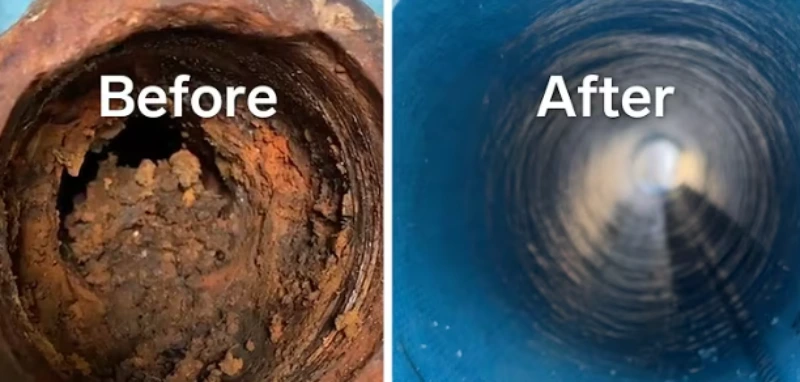
After enough 2004–2008 laterals, the patterns repeat. Root intrusion at joints: fine roots enter through microscopic joint gaps and grow into the flow — monsoon season supercharges them, which is why backups cluster after the first big storms. Bellies: low sags from soil movement that hold water and collect solids; the camera shows standing water in a line that should run dry between uses. Offsets: joints shifted by soil movement, catching paper and grease until the line chokes. Scale and grease: hard-water scale (Maricopa’s official water report runs ~13.5 grains per gallon, with 803 ppm TDS) narrows old laterals from the inside, and kitchen grease from two decades of cooking coats the walls. Each pattern has a different fix — and the camera is the only way to tell them apart. A plumber who diagnoses your sewer by listening to symptoms is practicing veterinary medicine on your yard.
Detection methods, explained like you’re standing there
This is where the East Valley’s best operators — Second Opinion Plumbing publishes the deepest real-operator sewer and slab content in the region, and we’ll say so honestly — set the bar: they teach the methods, not just the sale. Here is the honest version. Push camera: the workhorse, 100–200 feet of cable, sees everything a straight run can reach. Locator sonde: the transmitter in the camera head lets us mark depth and position from above — this is what turns “somewhere in the front yard” into a three-foot dig window. Hydrostatic/flow testing: for suspected breaks under the slab, isolating sections and watching water levels tells us whether the leak is supply-side (your slab leak page covers that) or in the drain system. Dye testing: simple, cheap, and surprisingly decisive for suspected cross-connections. What we don’t do: sell you a repair for a line we haven’t seen. If the camera shows a clean line with one root ball at 42 feet, you get a root cut and a maintenance plan — not a replacement quote.
Sewage backing up right now?
Don’t wait — sewage is a health hazard. A live dispatcher answers 24/7.
📞 (866) 471-4088Trenchless vs. Open Dig: What Qualifies, What Doesn’t
Trenchless sewer repair is real, it works, and it is not right for every line. Here is the honest breakdown for Maricopa laterals.
How trenchless actually works
Two trenchless methods matter for residential laterals. Cured-in-place pipe (CIPP) lining: a resin-saturated liner is pulled or inverted through the existing line and cured in place, creating a smooth new pipe inside the old one — no trench, typically two small access pits. Pipe bursting: a bursting head fractures the old pipe outward while pulling a new HDPE line through behind it — same path, brand-new pipe, minimal excavation. Both leave your driveway, landscaping, and the new paver patio you installed in 2022 largely intact. For a Maricopa homeowner, the appeal is obvious: the laterals here run under front yards, walkways, and sometimes driveways that cost real money to restore.
When trenchless qualifies — and when it doesn’t
The camera decides. Trenchless lining needs a host pipe that still holds its shape: cracked joints, root intrusion, and moderate scale are fine; a fully collapsed section or a severe belly is not, because the liner follows the old pipe’s shape — lining a belly gives you a smooth new belly that still holds water. Pipe bursting handles worse damage but needs room for the bursting head and a clear pull path. Caliche matters here too: bursting through caliche-cemented soil around the old pipe can require upsized equipment or rule bursting out. This is the part of the sales pitch that usually gets skipped: a contractor who recommends trenchless without camera footage is selling a method, not a diagnosis. We have turned homeowners away from trenchless when the camera showed a collapsed section — and we’ve saved driveways with lining when the host pipe qualified. The footage makes the call, and you see it.
| Factor | Trenchless (lining / bursting) | Open dig & replace |
|---|---|---|
| Yard & hardscape damage | Minimal — small access pits | Full trench; driveway/walkway restoration extra |
| Caliche risk | Mostly avoided — works inside the old pipe | Full exposure to whatever the soil holds |
| Fixes bellies & collapses | No — follows the old pipe’s shape | Yes — new line, correct grade |
| Typical timeline | 1–2 days | 2–5 days + restoration |
| Best for | Cracked joints, root intrusion, scale in a sound host pipe | Collapses, severe bellies, shallow lines, re-grades |
| How the decision is made | Camera footage + locator depth. You watch, we measure, then we recommend. | |
Wondering if your line qualifies for trenchless?
One camera visit answers it — and you’ll see exactly what we see.
Call — (866) 471-4088Monsoon Roots: Why Backups Cluster After the First Big Storm
Every summer, Maricopa’s sewer calls spike with the storms. It is not a coincidence — it is botany.
Roots hunt water, and your lateral leaks vapor
Trees don’t need a broken pipe to find your sewer — they need a joint. Sewer laterals in 2004–2008 tract homes are typically joined in sections, and every joint is a microscopic gap where water vapor escapes into the surrounding soil. Roots follow the moisture gradient straight to it. Fine root hairs enter through gaps you couldn’t slide paper through, then grow inside the nutrient-rich flow until they form a mat that catches paper, grease, and everything else. Maricopa’s desert landscaping actually concentrates the problem: a mesquite or palo verde in a gravel yard has few water sources, so the one constant moisture signal — your lateral — gets the tree’s full attention.
The monsoon growth spurt
Monsoon season is root Christmas. The first big downpours saturate the soil, trees that have been dormant through the dry heat explode with growth, and root intrusion that was a minor nuisance in May becomes a full blockage by August. The pattern we see every year: a homeowner in Tortosa or Rancho Mirage has slow drains “for a while,” the first monsoon hits, and the guest bathroom backs up during a storm weekend. The roots didn’t arrive with the rain — they were already inside, and the storm’s growth surge plus extra groundwater infiltration finished the job. If your drains have been “a little slow” since spring, get the camera in before monsoon, not after.
Cutting roots vs. fixing the entry point
A root cut — running a cutting head down the line — clears the blockage and restores flow, and for a minor intrusion it is the right call. But cutting doesn’t close the entry point: the joint gap is still there, and in Maricopa’s growing seasons roots return in 12–24 months. The permanent fix is closing the gap — spot repair at the joint, lining the section, or replacing it. We’ll tell you straight which one your camera footage supports: a single intrusion point in an otherwise sound 2006 lateral gets a cut and a maintenance schedule; three intrusion points with a belly behind them gets a repair conversation. Either way, you see the footage and you make the call.
Drains slowing down as monsoon builds?
A camera visit now beats a sewage backup at 10 PM during a storm.
Call — (866) 471-4088Spot Repair vs. Reroute vs. Replace: The Full Decision Tree
Most sewer pages give you two options: repair or replace. The real decision has more branches — and permits, and insurance paperwork.
The five real options, in order of invasiveness
1. Root cut / descaling: mechanical clearing of roots and hard-water scale. Right for minor intrusion in a sound line. Maintenance, not repair.
2. Spot repair: excavate at the one bad joint or crack the locator marked, replace that section. Right for a single defect in an otherwise healthy lateral — the most common fix we do on 2000s Maricopa homes.
3. Sectional lining: trenchless liner across a bad stretch — multiple cracks, moderate root damage — without digging up the yard.
4. Full lateral replacement (open dig): new line from house to city main, correct grade, new materials. Right for collapses, severe bellies, or a lateral with defects every ten feet.
5. Reroute: abandon the failed path and run a new line on a better route — useful when the old line runs under a new addition, a pool, or mature trees you won’t sacrifice. The honest version of this list is that options 2 and 3 solve the majority of what our cameras find. Anyone who jumps straight to option 4 without showing you why options 2 and 3 fail is selling you their favorite job, not your best fix.
Permits: the part nobody mentions until the inspector does
Sewer lateral work in Maricopa typically requires a permit and inspection — you are connecting to the city’s system, and the city wants to verify grade, materials, and the connection at the main. Unpermitted sewer work surfaces at the worst possible moment: during a home sale, when the buyer’s inspector asks for the permit record, or when a future backup traces to a bad connection nobody inspected. Here is the local-market truth worth knowing: of the plumbers advertising in Maricopa, only Kooline and AAM display ROC license numbers publicly, and nobody teaches homeowners how to verify a license at roc.az.gov. We do: every job we run is permitted where the city requires it, inspected, and documented — and we encourage you to verify any contractor’s ROC number before they dig. A sewer repair without a permit is a discount you pay for twice.
Insurance documentation: boring, and worth money
Homeowner’s insurance sometimes covers sewer line damage — “sometimes” doing heavy lifting, because standard policies often exclude wear-and-tear and root intrusion while covering sudden damage (a collapse from an external event, for example). The difference between a covered claim and a denied one is usually documentation: dated camera footage showing the defect, a written diagnosis with measurements, the permit record, and before/after photos. We produce all of it as standard practice on every sewer job — not as an upsell. If your situation looks claimable, you will have the file your adjuster needs. If it doesn’t, you’ll know that before filing, which is worth something too.
“What plumbing problem keeps getting postponed?”
That is a real question a local Maricopa plumber put to neighbors this year — and sewer lines are the classic answer. A slow drain gets plunged, then snaked, then lived with, for months or years, while the belly deepens and the roots thicken. Postponed sewer problems don’t stay the same price: a root cut in spring becomes a spot repair by fall becomes a replacement after the line collapses under a monsoon-soaked yard. The camera visit is the cheapest sewer money you will ever spend, because knowing exactly what is down there is what keeps a small problem small.
Postponing a sewer problem?
Find out what it actually is before it finds out for you. Camera visit, live footage, straight answer.
Call — (866) 471-4088What Sewer Line Repair Costs in Maricopa
Budgeting guidance from the open market — framed as ranges to plan with, not quotes. Your price comes from your camera footage, in writing, before any work.
Why nobody publishes sewer prices (and what we can tell you anyway)
No ranked Maricopa plumbing page publishes real sewer numbers. The reason is partly legitimate — depth, soil, access, and method swing the price enormously, as the caliche section above explains — and partly habit. What we can share honestly: the only published Phoenix-area plumbing numbers we found come from Madrid Plumbing’s blog, which lists slab leak detection at $200–$600 and slab leak repair at $1,500–$4,500. Those are slab numbers, not sewer numbers — shown as metro market context, not our pricing — but they illustrate the honest pattern: detection is a few hundred, repair is a few thousand, and the spread comes from what the camera finds. For sewer line repair in Maricopa, AZ, the cost drivers in order are: depth of the break, caliche or rock in the dig path, access (under driveway vs. open yard), method (spot repair vs. lining vs. full replacement), and restoration. A shallow spot repair in clean soil and a deep full replacement through caliche are different jobs that happen to share a name.
The cost drivers, ranked
| Cost driver | Cheaper end | Expensive end |
|---|---|---|
| Depth of defect | 3–4 ft, hand-diggable | 6–8 ft at the property line, shoring required |
| Soil | Clean alluvium | Caliche lens — rock equipment, bigger machine |
| Access | Open yard | Under driveway, walkway, or mature landscaping |
| Method | Spot repair at one joint | Full replacement or bursting |
| Restoration | Sod patch | Concrete, pavers, irrigation rebuild |
Use this table when comparing quotes: if one bid is dramatically lower, check which row it skipped. The most common trick in sewer quoting is pricing the dig as if the soil were clean and the depth shallow — then discovering caliche on day two, when you are past the point of saying no.
Our answer: the number comes first
We can’t price your lateral through a website, and we won’t pretend to. What we commit to: camera footage you watch live, a flat-rate number in writing before any digging, and a clear explanation of which cost driver is driving your number. If the scope changes mid-job — the camera missed a second defect, the caliche is worse than the locator suggested — you approve the new number before we continue. And the “cheaper is not always cheap” warning from a Maricopa homeowner about unlicensed side-work applies double to sewer: an unpermitted, uninspected lateral replacement is the most expensive “deal” in plumbing.
Got a sewer quote that feels off?
Free quote reviews — bring us the footage or we’ll run our own camera and give you our honest read.
Get a Second OpinionWhat We Commit To — In Writing
Not reviews we wrote ourselves. Commitments you can hold us to.
Price in writing first
Flat-rate number before any digging. If the camera reveals a second defect mid-job, you approve the new number before we continue — no “while we were down there” ambush.
Show-you diagnosis
You watch the camera footage live — the distance counter, the defect, the depth reading. We prove the break before we price the fix. No footage, no sale.
Licensed, permitted, inspected
Every sewer job goes to a licensed Arizona plumber, permitted where the city requires it, and inspected. Verify any ROC license at roc.az.gov — we encourage it.
24/7 live answer
Sewage backups don’t keep office hours. Nights, weekends, holidays — a dispatcher picks up, not a call center in another state.
No-pressure second opinions
Got a five-figure sewer quote that smells wrong? We’ll run our own camera and give you our honest read — even if the answer is “that quote is fair.”
Plain-language explanations
One Maricopa homeowner asked a local plumber, “does he speak spanish so I can reference him” — because trust starts with being understood. We explain every finding in plain language, and we’ll walk your Spanish-speaking family members through the footage too.
Hold us to it.
If we ever break one of these, tell us — we’d rather hear it than lose you.
Call — (866) 471-4088What Maricopa Sewer Jobs Actually Look Like
Typical scenarios based on the housing stock, soil, and monsoon patterns we see across Maricopa — illustrative patterns, not real customers.
The 2006 Lateral With Three Root Balls
The situation
A homeowner in the Villages at Rancho El Dorado notices the guest bathroom gurgling every time the washer drains — “a little slow for a while,” then suddenly backing up after the first monsoon storm. The home was built in 2006; the lateral has never been camera-inspected.
What we found
The camera showed a sound host pipe with three distinct root intrusions at joints — 38, 61, and 84 feet — plus a shallow belly holding water behind the second one. No collapse, no offsets. The homeowner watched the whole run on the monitor and saw each root mass herself.
The fix
Root cutting restored flow the same day, and the footage supported sectional lining across the bad stretch rather than a full replacement — the belly was shallow enough that regrading wasn’t required. One access pit, liner cured in place, roots locked out permanently. The drain cleaning maintenance plan covers the rest of the line.
The Spot Repair That Hit Caliche
The situation
A Tortosa homeowner gets two sewer quotes for a single bad joint the first plumber’s camera found at 5 feet deep. Quote one is suspiciously cheap; quote two is thousands higher. She calls us for the tiebreaker.
What we found
Our camera confirmed the single offset joint — and our locator confirmed the depth. The difference between the quotes was the soil: the cheap bid priced a clean hand-dig, while the basin’s documented caliche layers made a clean dig unlikely at that depth on that street. We probed, confirmed hard caliche at 3 feet, and priced the rock equipment honestly.
The fix
Spot repair at the marked joint with the right equipment on day one — no mid-job “discovery” surcharge, because the caliche was in the written price. Permitted, inspected, documented with before/after footage for the homeowner’s file. The cheap quote would have doubled on day two.
The Collapsed Line Under the New Driveway
The situation
A Moonlight homeowner (85139) has raw sewage surfacing near the cleanout after a monsoon week. The camera shows a fully collapsed section at 7 feet — soil movement plus a heavy vehicle parked over the line during construction. Trenchless is off the table: the host pipe is gone.
What we found
Collapse at 64 feet, 7 feet deep, running under the edge of a two-year-old paver driveway. The rest of the lateral is sound. This is the “different job that shares a name” case: depth, access, and restoration all stack.
The fix
Open dig and replace the collapsed section with correct grade, pavers lifted and reset by the crew, irrigation line rerouted around the new pipe. Permitted and inspected by the city, with the full documentation file — camera footage, permit record, before/after photos — handed to the homeowner for insurance and resale records. Not the cheapest fix. The right one.
Sound familiar?
Describe your symptom — we’ll tell you straight whether it’s a root cut or a repair.
Call — (866) 471-4088Related Services
Sewer problems rarely travel alone in 2000s Maricopa homes. If your lateral is aging, the supply side deserves a look too — slow drains everywhere can also start as a drain cleaning issue before it becomes a sewer one, and homes from the 2004–2008 wave with copper in the slab should know the slab leak warning signs. Neighbors in Pinal County deal with the same basin soils — see our sewer line repair in Casa Grande for the county-wide picture. And if you’re comparing service areas statewide, our Arizona plumbing service areas page maps every city we cover.
Not sure which problem you have?
One call sorts it — describe the symptom and we’ll point you at the right fix, even if it’s the cheaper one.
Call — (866) 471-4088Proudly Serving All of Maricopa, AZ
From Rancho El Dorado’s 2000s villages to the new builds rising in 85139 — camera-located sewer repair across every Maricopa neighborhood, 24/7.
ZIP codes served: 85138 · 85139
Near Copper Sky Regional Park, Pacana Park, Harrah’s Ak-Chin Casino, and along SR 347 — if you’re inside Maricopa city limits, you’re in our service area.
Maricopa Sewer Line FAQs
The questions Maricopa homeowners actually ask about sewer line repair — answered straight.
How much does sewer line repair cost in Maricopa, AZ?
Honest answer: it depends on depth, soil, access, and method — which is exactly why we won’t quote through a website. As budgeting guidance (not a quote): the only published Phoenix-area plumbing numbers we found are Madrid Plumbing’s slab leak figures — detection $200–$600, repair $1,500–$4,500 — shown as metro market context. Sewer work follows the same shape: the camera visit is the small money, the repair is driven by what the camera finds. Depth of the break, caliche in the dig path, and whether the fix is a spot repair or a full replacement move the number more than anything else. What we commit to: camera footage you watch live, then one flat-rate number in writing before any digging.
How do I know if my sewer line is broken or just clogged?
Clogs affect one fixture; sewer line problems affect the whole house. The tell-tale signs: multiple drains slow at once, toilets gurgling when the washer drains, sewage smells in the yard, or water backing up at the cleanout. A single slow sink is a drain cleaning problem; every fixture misbehaving at once is a lateral problem. The only way to know for sure is a camera: we run it from the cleanout, you watch live, and the footage shows whether it’s a root ball, a belly, a break, or just buildup.
What is trenchless sewer repair, and does my line qualify?
Trenchless repair fixes the pipe from the inside — either a cured-in-place liner that creates a new pipe within the old one, or pipe bursting that fractures the old line while pulling a new one through. It qualifies when the host pipe still holds its shape: cracked joints, root intrusion, and moderate scale are good candidates. It does not qualify for collapsed sections or severe bellies, because the liner follows the old pipe’s shape. The camera decides, and you see the footage before anyone recommends anything.
Does Maricopa’s soil really make sewer repairs more expensive?
It can. Maricopa sits on Santa Cruz basin alluvium, and USGS well logs document hard caliche layers — calcium-carbonate-cemented soil that a backhoe bounces off. When a dig hits caliche, the job needs rock equipment and a bigger machine, which costs more than a clean-soil dig at the same depth. That’s why two quotes for the same repair can differ by thousands: one priced clean soil, the other priced the caliche. A camera with a locator tells us depth and location; probing tells us soil. Any quote without both is a guess.
Will my homeowner’s insurance cover a sewer line repair?
Sometimes — and “sometimes” is doing heavy lifting. Standard policies often exclude wear-and-tear and root intrusion but may cover sudden, accidental damage. The difference between a paid claim and a denied one is documentation: dated camera footage, a written diagnosis with measurements, the permit record, and before/after photos. We produce all of it as standard practice on every sewer job. If your situation looks claimable, you’ll have the file your adjuster needs; if it doesn’t, you’ll know before filing.
Do I need a permit for sewer line repair in Maricopa?
Typically yes — sewer lateral work usually requires a permit and inspection, since you’re connecting to the city’s system and the city verifies grade, materials, and the connection at the main. Unpermitted sewer work surfaces at the worst moment: during a home sale, when the buyer’s inspector asks for the permit record. We permit every sewer job where the city requires it and hand you the documentation. And verify any contractor’s license at roc.az.gov before they dig — legitimate plumbers expect you to check.
How fast do roots grow back after a sewer line is cleared?
In Maricopa’s growing seasons, expect 12–24 months after a root cut — cutting clears the blockage but doesn’t close the joint gap the roots entered through. Monsoon season accelerates regrowth, which is why backups cluster after the first big storms. The permanent fix is closing the entry point: spot repair at the joint, sectional lining, or replacement. We’ll tell you straight which one your footage supports — a single intrusion point gets a cut and a maintenance schedule; multiple intrusions with a belly get a repair conversation.
Sewage is backing up into my house right now — what do I do?
Stop using water immediately — every flush and every faucet adds to the backup. Don’t use chemical drain cleaners; they won’t clear a lateral blockage and they make the eventual repair more hazardous. If sewage has reached floors, keep people and pets away from it — it’s a health hazard. Then call (866) 471-4088: a live dispatcher answers 24/7, and emergency sewer calls get priority routing. We’ll camera-locate the blockage and restore flow before talking about the permanent fix.
Still have questions?
Call and ask a real plumber — not a chatbot, not a call center.
Ask Us — (866) 471-4088Maricopa’s Sewer Line Repair — Camera First, 24/7
Watch the footage live, get the price in writing, then decide. That’s the whole pitch — from the sewer line repair Maricopa, AZ homeowners call before they dig.
📞 (866) 471-4088Live dispatcher · Licensed Arizona plumbers · Upfront flat-rate pricing