#1 Leak Detection Prescott, AZ
A hidden leak can run for months behind walls or under your slab. We pinpoint it with acoustic and thermal instruments — no guesswork, no demolition.
24/7 live answer · Serving Prescott & Prescott Valley · Flat fee confirmed before we start · We mark the exact spot
Prescott’s Hidden Leaks Cost You Twice
Every drop of water in Prescott is pumped from deep underground. The City runs about 27,231 service connections and 572 miles of pipeline, pulling 100% of its supply from wells drilled into the volcanic aquifer under the Little Chino basin. That water is not cheap to deliver — which means a hidden leak costs you twice: once on the water bill, and again on the damage it does while nobody is watching.
And Prescott homes are built for leaks to hide. The city’s own water quality reports put hardness at 4.3 to 7.6 grains per gallon — moderately hard, official figure — and scale plus pressure are the two great accelerators of pipe failure. Local plumbing pros report street supply pressure above 80 PSI in parts of Yavapai County — well past the recommended residential range — and the City of Prescott’s own guidance warns that a failing pressure regulator causes banging, hammering, and the kind of fitting stress that turns into pinholes. Add freeze-thaw cycles at 5,373 feet of elevation, granite bedrock under your slab, and pre-1960s galvanized lines in the historic core, and you have a city where supply lines fail quietly, behind drywall and beneath concrete.
That is exactly what leak detection in Prescott is built to do. A trained technician with the right instruments does not guess, does not open walls on a hunch, and does not charge you for exploratory demolition. Acoustic listening finds the hiss of a pressurized leak through concrete. Thermal imaging sees the heat signature of a hot-water line bleeding under your floor. Electronic line tracing maps where your buried lines actually run before anyone digs. Pressure testing proves which line is leaking — and rules out the ones that are not.
Most leaks we confirm end up as straightforward repairs: a slab leak repair for lines under the foundation, a burst pipe repair when winter does its worst, or a water heater repair when the tank or its connections are the culprit. Detection is the step that makes those repairs surgical instead of expensive. If you are anywhere in the Prescott service area, start here: the sooner a leak is located, the smaller the repair.
Six Signs You Have a Hidden Water Leak
Hidden leaks rarely announce themselves with a puddle. They whisper. Here is what Prescott homeowners actually notice first.
Your Water Bill Jumps for No Reason
The most common first clue. Pull your last three City of Prescott or Prescott Valley bills and compare usage, not just the dollar amount. A sudden jump with no change in habits — no guests, no new landscaping — is a leak until proven otherwise. Prescott’s water is pumped groundwater; every wasted gallon shows up on the bill fast. Call us and we will tell you whether your usage pattern looks like a leak.
You Hear Water When Nothing Is Running
A faint hissing, whooshing, or trickling sound behind a wall or under the floor — with every faucet off — is the sound of pressurized water escaping a pipe. This is the classic slab leak symptom in Prescott homes: copper lines under the slab develop pinholes and sing before they flood. Acoustic detection equipment hears what your ears only hint at.
Warm Spots on the Floor
Walk barefoot across your tile or wood floors. A patch that feels noticeably warmer than the surrounding floor usually means a hot-water line is leaking underneath it. The escaping hot water heats the slab from below. This sign is specific enough that when homeowners describe it to us, we are already reaching for the thermal camera before we hang up.
Musty Smells, Stains, or Warping
A slow leak inside a wall cavity feeds mold long before it feeds a puddle. Watch for a musty smell in a bathroom or laundry room, paint that bubbles, baseboards that pull away, or wood flooring that cups at the edges. By the time you see the stain, the leak has usually been running for weeks — which is exactly why locating it precisely matters more than patching the drywall.
Pressure Drops or Pipes That Bang
A leak bleeds pressure from the system, so showers weaken and fixtures sputter. Banging or hammering — what plumbers call water hammer — points at pressure problems: the City of Prescott itself notes that a failing pressure regulator causes exactly this. Street pressure above 80 PSI, reported in parts of the county, stresses every joint in the house, and water heater connections are often the first to weep. A gauge test takes minutes and tells the whole story.
Your Meter Spins With Everything Off
The homeowner test: turn off every faucet, the ice maker, the irrigation, and the washing machine. Then watch your water meter. If the low-flow dial or triangle keeps moving, water is going somewhere — and it is not going through a fixture. Note the reading, wait 30 minutes without using water, and read it again. Movement means a leak, and it tells us roughly how serious it is before we even arrive.
Describe the symptom and we will tell you honestly whether it sounds like a leak — free.
How Professional Leak Detection Actually Works
There is no single magic tool. Professional leak detection in Prescott is a stack of instruments, each answering a different question — where is the line, is it leaking, and exactly where.
A proper detection visit follows an order. First we interview: when did the bill change, where do you hear the sound, which fixtures act strangely. Then we meter-test to confirm water is actually escaping. Then we choose instruments based on what the house tells us — slab foundation or crawlspace, hot side or cold side, copper or galvanized. Here is what each method does and when it earns its place.
Acoustic Listening
Pressurized water escaping through a pinhole or crack makes noise — a hiss or whoosh that travels through the pipe and the surrounding material. Ground microphones and electronic listening discs amplify it, and a trained ear reads the pitch and location. On Prescott’s slab-on-grade homes this is the workhorse: it can pinpoint a copper pinhole under concrete to within inches, which is the difference between one small access hole and a trench across your living room.
Thermal Imaging
Infrared cameras see temperature, not water. A hot-water line leaking under a slab paints a warm bloom on the floor surface that the camera reads clearly; a cold-water leak shows as a cool anomaly against the slab’s ambient temperature. Thermal is fastest on hot-side leaks and excellent for scanning large areas quickly — walls, ceilings, and floors — before we commit to the slower acoustic pinpoint.
Electronic Line Tracing
Before anyone digs, we need to know where the pipe actually runs. A tone generator clips onto an accessible point of the line and sends a signal through it; a receiver above ground follows that signal and maps the line’s path and depth. In granite country this step is non-negotiable — trenching through Prescott rock is slow and expensive, so you trace first and dig exactly once.
Pressure Testing & Isolation
The proof step. We attach a gauge, pressurize or isolate sections of the system, and watch. A line that will not hold pressure is leaking — full stop. By valving off zones (hot vs. cold, house vs. irrigation, upstairs vs. downstairs) we narrow the search before the instruments come out. This is also how we rule things out: a steady gauge on the house lines with a dropping irrigation zone means your leak is in the yard, not under the slab.
| Method | What it finds | When we use it |
|---|---|---|
| Acoustic listening | Pressurized leaks in supply lines, pinholes under slab | Slab-on-grade homes, copper lines, “I hear water running” calls |
| Thermal imaging | Hot-water line leaks, moisture patterns in walls and floors | Warm-floor complaints, large-area scans, ceiling stains |
| Electronic line tracing | Buried line routes and depths before digging | Yard leaks, granite terrain, any job where a shovel comes out |
| Pressure testing | Which zone is leaking; confirms a leak exists at all | Every visit — first to confirm, last to verify the fix |
| Moisture meters | Dampness inside walls and under flooring | Stain and musty-smell investigations, damage mapping |
One honest note about cameras: the video inspection cameras you hear about are for drain and sewer lines — they travel inside the pipe and show cracks, roots, and breaks. For pressurized supply-line leaks, acoustic, thermal, tracing, and pressure testing are the instruments that matter. If your problem turns out to be on the drain side, that is a different specialty — and a burst or broken line repair starts with knowing which system failed.
One visit, every method the situation calls for, flat fee confirmed upfront.
Is It a Slab Leak — or Is Your Foundation Just Settling?
In granite country, this is the question that confuses everyone, and it is the reason leak detection matters so much here. Prescott sits on some of the oldest rock in Arizona — the Granite Dells north of town expose coarse-grained granite about 1.4 billion years old, weathering into the decomposed-granite “grus” gravel that underlies much of the area. Rock is stable, which sounds good for a slab. But just a few miles south, Prescott Valley sits on very different ground: expansive clay soils, the same clay the EPA has sought out for capping mine tailings, that swell and shrink with the seasons.
That split creates two different slab stories. In Prescott proper, slabs rarely move — but trenching through granite bedrock to reach a buried line is brutally slow and expensive, which makes pinpoint accuracy worth real money. A leak located to within inches means one surgical access point; a leak located “somewhere under the living room” means a contractor with a jackhammer billing by the hour. In Prescott Valley, the clay genuinely moves: slabs and sewer laterals shift as the soil swells with monsoon moisture and shrinks in dry months, stressing joints and copper lines until pinholes and cracks open.
Here is how the confusion starts. Expansive-soil movement shows up as hairline cracks in drywall, doors that stick, and small gaps at baseboards — and a homeowner reasonably assumes “foundation settling.” But a slab leak shows up as warm spots on the floor, the sound of running water with everything off, a climbing water bill, and damp carpet edges. The two can look alike from the outside, and the treatments are completely different: one is a foundation question, the other is a plumbing emergency that gets worse every day it runs.
Detection settles it in a single visit. Acoustic listening and pressure testing do not care what the soil is doing — they answer one question: is pressurized water escaping under this slab, and exactly where. If the answer is yes, you are looking at a slab leak repair, and the location we mark is where the repair starts. If the answer is no, you have saved yourself from paying a plumber to chase a foundation problem — and you know to call a foundation specialist instead. Either way, you stop guessing.
Why Does My Historic Prescott Home Keep Getting Pinhole Leaks?
Walk the blocks around Courthouse Plaza and Whiskey Row and you are walking through plumbing history. After the Great Fire of July 14, 1900 destroyed five city blocks, the district was rebuilt by 1901 in brick, concrete, and stone — and the homes in Prescott’s historic districts (East Prescott, West Prescott, Hassayampa, Fleury’s Addition, Pine Crest, and the rest, with 700-plus properties on the National Register) carry supply plumbing from eras when galvanized steel was the standard.
Galvanized steel pipe fails from the inside out. The zinc coating that protects it erodes over decades, and then the steel itself starts corroding. The pipe looks fine from the outside while the interior narrows with scale and rust — until the wall gets thin enough that pressure punches through. That is a pinhole leak: a tiny, high-pressure spray inside a wall cavity that can run for weeks before anyone notices. Pre-1960s Prescott homes with original galvanized lines are living on borrowed time, and two local accelerators make it worse: moderately hard water at 4.3–7.6 grains per gallon laying down scale, and the above-80-PSI street pressure reported in parts of the county hammering every weakened spot.
The pattern we see in the historic core is consistent. First one pinhole behind a bathroom wall. Then another under the kitchen sink six months later. Then a third. Each one gets patched, and each patch costs a drywall repair on top of the plumbing. At some point the math flips: the house does not need another patch, it needs the galvanized retired — a reroute or repipe in modern PEX or copper. Detection is what tells you where you are on that curve. If acoustic listening finds one isolated pinhole in an otherwise sound run, a spot repair makes sense. If pressure testing shows the whole system weeping, we will tell you straight that another patch is throwing money at a failing system.
| Home era | Typical pipe stock | Leak pattern we find |
|---|---|---|
| Pre-1960s (historic core) | Galvanized steel supply; cast-iron or clay sewer laterals | Interior-corrosion pinholes; root intrusion at clay joints downtown |
| 1978–1995 | Polybutylene supply in many builds | Brittle-fitting failures; whole-system risk, not isolated leaks |
| 2000s and newer | PEX or copper | Joint stress from soil movement; water-heater connection weeps; freeze splits |
Two more Prescott-specific notes. First, the clay sewer laterals in the historic districts invite root intrusion — pine and juniper roots find every old joint near downtown, which is a drain problem, not a supply-leak problem, and the fix is different. Second, winter: at 5,373 feet, Prescott gets genuine freezes, and the City’s own winterization guidance warns that freezing water bursts pipes. An uninsulated hose bib or an exposed line on a north wall can split in one hard night, and that is a burst pipe — sudden, obvious, and very different from a slow pinhole. Knowing which failure you have determines everything about the repair.

What Happens After We Find the Leak?
Finding the leak is half the job — and it is the half most companies skip over. Here is exactly what happens after our instruments mark the spot.
1. We Mark It and Show You the Evidence
You do not take our word for it. We mark the exact location, show you the acoustic reading or thermal image, and show you the pressure-test result that proves the line is leaking. You will know what failed, where it failed, and why — before any repair conversation starts.
2. You Get Itemized Repair Options
Not one take-it-or-leave-it number. Depending on what we found, you may have a choice: a spot repair at the pinhole, a reroute that abandons the failing run entirely, or a partial line replacement. Each option comes with its own price and its own honest assessment of how long it lasts — so you can choose with open eyes.
3. The Repair Goes to the Right Specialist
A confirmed slab leak hands off to our slab leak repair process — surgical access, minimal concrete removed, lines rerouted or replaced. A freeze-split line becomes a burst pipe repair. A weeping tank or failed connection becomes a water heater repair. Detection and repair stay connected, so nothing gets lost between the diagnosis and the fix.
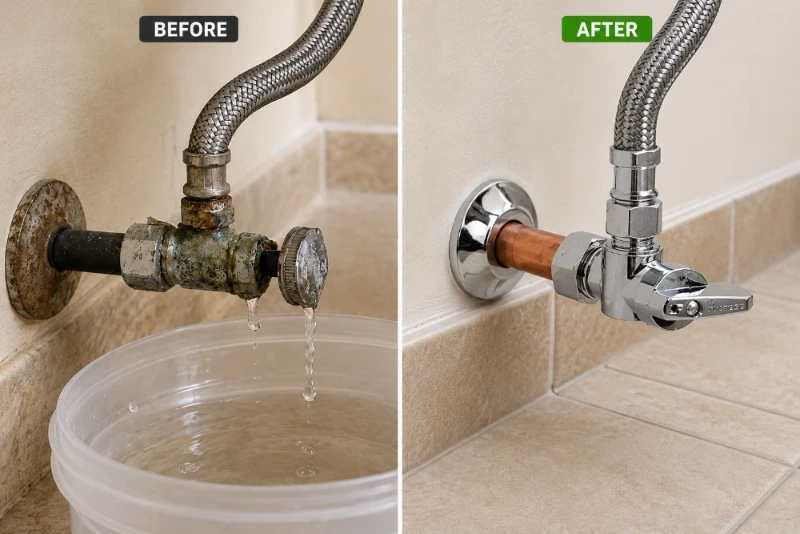
One promise that matters: there is no obligation. The detection visit stands on its own. If you want a second opinion on the repair, take our marked location and our documentation and get one — any honest plumber will thank you for handing them a located leak instead of a mystery. Most homeowners do not bother, because the evidence is right there in front of them.
Stop Guessing Where the Water Is Going
One visit. Every instrument the situation calls for. The exact spot, marked and documented.
📞 Call (866) 471-4088What Does Leak Detection Cost in Prescott?
No invented price lists here — any company quoting you an exact repair number without seeing the leak is guessing with your money. What we can tell you honestly is how detection is priced and what moves the number.
A leak detection visit in Prescott typically lands between about $150 for a straightforward locate and $400 or more when the job involves multiple zones, slab testing, and electronic line tracing. That range reflects what local shops actually advertise for detection and simple locates — not a national template number. Your exact fee is confirmed in writing before we start, and it does not change when we are done.
What moves the number up or down:
Accessibility of the Lines
A leak in an exposed garage or crawlspace line is a fast locate. A leak under a slab in granite country takes acoustic pinpointing, thermal scanning, and sometimes line tracing — more instrument time, more expertise, higher fee. Precision is what keeps the repair small.
How Many Zones We Test
A single-zone pressure test on the house lines is quick. A full workup — house lines, irrigation zones, and a slab-line isolation — takes longer. We will tell you upfront which testing your symptoms actually require, and we do not sell testing you do not need.
Fee Credited Toward Repair
If we find the leak and you have us do the repair, the detection fee is credited against the repair cost. You do not pay twice for the same problem. And if we confirm there is no leak — it happens, usually a meter or irrigation-timer issue — you pay only the visit, and you have proof.
Describe the symptoms — we will quote the detection visit upfront, in writing.
Our Service Commitments
Not testimonials — promises we make before we touch a wrench.
24/7 Live Answer
A leak does not wait for business hours, so neither do we. Nights, weekends, holidays — a person picks up, and emergency calls get same-day response across Prescott and Prescott Valley.
Upfront Flat Fee
The detection fee is confirmed before we start, in writing. No hourly meters running while we listen, no surprise add-ons when the job is done.
Non-Invasive First
Instruments before demolition, always. We do not open a wall or cut concrete on a hunch — only on a located, proven leak.
Marked and Documented
Every located leak is marked on the spot and documented with readings you can keep — useful for insurance, for second opinions, and for the repair itself.
Repair-Path Honesty
If a spot repair is the wrong move for a failing system, we say so. If your galvanized lines are done, you will hear “repipe” instead of a third patch quote.
Clean Work, Every Time
Shoe covers, drop cloths, and a cleanup when we leave. Detection should not leave your home looking like a construction site.
Three Typical Scenarios
Representative situations based on the leak patterns Prescott homes actually produce — not real jobs, but the shape of real calls.
The 1940s Bungalow Near Courthouse Plaza
A homeowner in the 86303 historic district notices the water bill climbing for three straight months and hears a faint hiss behind the kitchen wall late at night. Acoustic listening traces it to a pinhole in the original galvanized supply line — interior corrosion, exactly the pattern pre-1960s pipe produces. Because the rest of the run tests sound on pressure, a targeted reroute through the attic solves it in one day: no more galvanized in that wall, no exploratory demolition.
The takeaway: in the historic core, one pinhole is a warning, not just a repair. Detection tells you whether the system has years left or months.
The Prescott Valley Slab Question
A family in 86314 finds a damp edge along the carpet in the hallway and a new hairline crack in the drywall nearby. Is it the expansive clay shifting the slab, or is it a leak? Pressure testing isolates the hot-water line under the slab — it will not hold pressure — and thermal imaging shows the warm bloom right under the damp carpet. Slab leak, confirmed, located to within a foot. The crack was coincidence; the moisture was not. The handoff to slab repair starts from a marked spot instead of a mystery.
The takeaway: soil movement and slab leaks mimic each other in Prescott Valley. Instruments do not guess — they prove.
The Snowbird Home in 86305
Seasonal owners return in the fall to a water bill that ran all summer while the house sat empty. With no one home to notice symptoms, the meter test does the talking: the dial moves with every fixture off. Electronic line tracing follows the main from the meter, and the signal dies at a section of yard line where monsoon-season soil movement stressed an old joint. Located without digging up the whole yard, repaired the same week.
The takeaway: empty homes cannot report symptoms, so the meter becomes the witness. If you leave for the season, a meter check on return day is the cheapest leak test there is.
Tell us the symptom — we will tell you what it most likely is, free.
Serving Prescott & Prescott Valley
Our detection service covers the full Prescott area: downtown and the historic districts around Courthouse Plaza and Whiskey Row, Thumb Butte, Yavapai Hills, Prescott Lakes, the Ranch at Prescott, and Granville — plus all of Prescott Valley, from the 86314 neighborhoods to 86315. ZIP codes we serve daily: 86301, 86303, 86305, 86314, and 86315.
One local note worth knowing: Prescott and Prescott Valley run separate water systems. The City of Prescott pumps its own deep-well groundwater, while the Town of Prescott Valley operates its own utilities with its own water quality profile — including hardness around 7.2 grains per gallon. Our technicians test against the right baseline for whichever system feeds your home, because pressure norms and water chemistry genuinely differ across the town line.
Explore the rest of our Prescott plumbing services, browse every city in our Arizona service area, or if you are headed north, our Flagstaff team handles leak detection up at 7,000 feet.
Same-day detection visits available — call now.
Leak Detection Questions, Answered
Real homeowner questions we hear on Prescott calls — answered the way we answer them on the phone.
How much does leak detection in Prescott cost?
A straightforward detection visit typically runs between about $150 and $400 for most Prescott homes. Simple locates on accessible lines sit at the lower end; multi-zone testing, slab-line isolation, and electronic line tracing sit at the higher end. Your exact fee is confirmed in writing before we start, and if you have us do the repair, the detection fee is credited against the repair cost.
How do you find a leak without tearing up my floors?
We use instruments, not demolition. Acoustic listening equipment hears pressurized leaks through concrete and walls; thermal imaging cameras see the heat signature of hot-water leaks under floors; electronic line tracing maps buried lines before any digging; and pressure testing proves which zone is leaking. The combination usually pinpoints the leak to within inches, so any access work is surgical, not exploratory.
What are the signs of a hidden water leak?
The most common signs are a water bill that jumps with no change in usage, the sound of running water when every fixture is off, warm spots on floors, musty smells or paint bubbling on walls, unexplained drops in water pressure, and a water meter that keeps moving with everything shut off. Any one of these is worth a call; two or more together almost always mean a leak.
Can high water pressure cause leaks in Prescott?
Yes. Local plumbing pros report street supply pressure above 80 PSI in parts of Yavapai County, which is past the recommended residential range and accelerates wear at fittings, joints, and water heater connections. The City of Prescott’s own guidance notes that a failing pressure regulator causes high or low pressure and pipe-banging water hammer, and that the regulator is the homeowner’s responsibility. A simple gauge test shows your pressure in minutes.
How do I tell a slab leak from foundation settling?
Settling shows as drywall cracks, sticking doors, and baseboard gaps with no moisture. A slab leak shows as warm spots on the floor, the sound of running water with fixtures off, a climbing water bill, or damp flooring — water symptoms, not just movement symptoms. In Prescott Valley, expansive clay soils genuinely move slabs, which makes the confusion worse. Acoustic listening and pressure testing settle it in one visit: either pressurized water is escaping under the slab, or it is not.
My historic Prescott home has galvanized pipes. Should I worry about pinhole leaks?
If the galvanized lines are original to a pre-1960s home, yes — plan for it. Galvanized steel corrodes from the inside out, so the pipe looks fine until pressure punches a pinhole through a thinned wall. Prescott’s moderately hard water and the above-80-PSI street pressure reported in parts of the county both accelerate the process. Detection tells you where you stand: one isolated pinhole may merit a spot repair, but system-wide weeping means the lines are done and a repipe is the honest recommendation.
Do you offer leak detection in Prescott Valley too?
Yes — all of Prescott Valley, ZIP codes 86314 and 86315, with same-day response. Prescott Valley runs its own separate water system from the City of Prescott, with hardness around 7.2 grains per gallon, and its expansive clay soils shift slabs and stress joints differently than Prescott’s granite terrain. We test against the right baseline for your system and your soil.
What happens after you find the leak?
We mark the exact location, show you the evidence — the acoustic reading, thermal image, or pressure-test result — and give you itemized repair options with honest lifespan assessments for each. A confirmed slab leak moves to a surgical slab repair; a freeze-split line becomes a burst pipe repair; a weeping tank becomes a water heater repair. There is no obligation: the detection visit stands on its own, and the documentation is yours to keep.
Ready for Leak Detection in Prescott Without the Guesswork?
Describe the symptom — the bill, the sound, the warm floor — and we will bring the right instruments to find it. Same-day visits, flat fee confirmed upfront.
📞 Call (866) 471-4088