#1 Drain Cleaning Prescott, AZ
Slow drains, standing water, gurgling pipes? We clear clogs the right way — camera first, then the fix your drain actually needs. Call (866) 471-4088.
24/7 emergency drain service · Camera-first diagnosis on every job · Upfront pricing before any work starts · Serving Prescott & Prescott Valley
Why Prescott Drains Need a Different Approach
Most clogged drains in the Valley are grease and hair. In Prescott, they are something else entirely.
A slow drain in Prescott is rarely just a slow drain. At 5,373 feet, ringed by ponderosa pine and juniper, this town mixes some of Arizona’s oldest housing stock with some of its newest. Downtown, century-old homes still run on clay and cast-iron sewer laterals with joints every few feet — and pine roots have had decades to find every one of them. Out in Prescott Valley, the pipes are newer but expansive clay pockets shift with the seasons and stress every buried joint. Add moderately hard groundwater (the City’s own water report: 4.3 to 7.6 grains per gallon) laying down scale year after year, and you get drains that clog for Prescott-specific reasons — which is the kind of drain cleaning Prescott homeowners actually call us for.
Here is the problem with how most drain work gets sold: a tech shows up, runs a cable blind into your line, pokes a hole through whatever is in there, and leaves. The water drains for a while, you pay, and three months later the same drain backs up again. Nothing was diagnosed. Nothing was verified. If the whole house is affected — toilets gurgling when the washer runs, water in the tub when you flush — you may not have a drain problem at all but a main-line one, which belongs to our Prescott sewer line repair crew. Damp spots or a climbing water bill point to a hidden leak instead — our Prescott leak detection team finds those. Every drain cleaning Prescott call starts with the same question: what is actually in this pipe? We answer it with a camera before touching a single tool. See how we work across the area on our Prescott plumbing hub, or keep reading to learn what is really clogging drains up here.
What Is Actually Clogging Prescott Drains
Six patterns our techs see again and again up here — and why the fix is different for each one.
Pine & Juniper Roots
The signature Prescott clog. Ponderosa pine and Arizona juniper roots chase moisture year-round and slip into pipe joints — especially the clay laterals under the historic districts. A cable punches a hole through the root mat; the mat grows back in months. Read the full root deep-dive →
Hard-Water Scale
Some plumbers claim Prescott water is “very hard,” but the City’s own water report says 4.3–7.6 grains per gallon — moderately hard. Still, years of mineral film narrow pipe interiors, roughen the walls so debris catches, and shorten water-heater life. Scale-lined pipes clog faster and need more than a quick snake.
Grease That Sets Like Concrete
Kitchen grease hardens fast in Prescott because the soil and crawl spaces run cooler than the desert floor — a warm line in Phoenix is a cold line at 5,373 feet. Pour grease down the sink enough times and the line coats itself shut from the inside. Grease responds to jetting, not cabling.
Clay & Cast-Iron Laterals
Pre-1960s homes around Courthouse Plaza, Whiskey Row, and the historic overlay districts often still run original vitrified-clay or cast-iron sewer laterals. Clay joints every three to four feet are root entry points; old cast iron scales and flakes from the inside. When the camera shows a failing lateral, cleaning is a band-aid — our sewer line repair page explains the real options.
Granite & Shifting Soil
Prescott sits on 1.4-billion-year-old granite — stable, but sharp rock fragments and ground movement wear pipe walls over decades. Over in Prescott Valley, expansive clay pockets swell and shrink with moisture, shifting buried joints out of alignment. Misaligned joints catch debris and invite roots in.
Hair, Soap & Everyday Life
The ordinary stuff still counts: hair and soap scum in tubs, “flushable” wipes that are not, and seasonal-homeowner problems — a drain left dry for months while the owners winter elsewhere can crust shut and trap debris the moment water flows again. Simple clogs, honest cable jobs, no upsell.
Do Pine and Juniper Roots Really Get Into Drains?
Yes — and in Prescott, roots cause more repeat drain calls than grease, hair, and scale combined. Here is the full picture most competitors reduce to one sentence.
Prescott’s elevation puts it squarely in ponderosa pine and Arizona juniper country. Both are champion survivors of dry mountain climates, and the way they survive is by sending roots far and wide hunting for moisture. A sewer lateral is a warm, damp, nutrient-rich highway buried in otherwise dry ground — to a pine root, it might as well have a neon sign. Once a root hair finds even a hairline opening at a pipe joint, it follows the moisture inside, branches, and thickens. From that day on, your sewer line is not just a pipe. It is a fertilized garden bed, and the roots know it.
Which trees cause the trouble
Ponderosa pine is the worst offender in older Prescott neighborhoods. It drives a deep taproot but also spreads aggressive lateral roots that travel shocking distances — a mature ponderosa 40 feet from your house can reach your sewer lateral. Arizona juniper runs shallower but denser, forming fibrous root mats that press into every joint they touch. In the historic districts, older shade trees and fruit trees planted generations ago — elms, maples, old orchard remnants behind Victorian-era lots — contribute their share too. The tree does not have to be in your yard. If it is uphill of your lateral, its roots may already be there.
Root seasons in the high country
Roots do not grow evenly all year. In Prescott’s climate, growth surges twice: in spring (roughly April through June), when snowmelt and spring rain soak the soil, and again in the fall (September through October), when monsoon moisture and cooling soil trigger a second flush. Summer heat slows surface growth but barely affects roots already inside your pipe — they sit in a cool, wet tunnel while everything above ground bakes. Winter slows growth, but the roots never leave; they wait, already entrenched, until spring. That is why root backups arrive in waves: a line that drained fine in August clogs in October, gets snaked, then clogs again the following May.
How roots get in — and why downtown is ground zero
Roots enter at joints, not through solid pipe. The pre-1960s housing stock around Courthouse Plaza, Whiskey Row, and the twelve historic overlay districts still carries a lot of vitrified-clay sewer laterals — pipe laid in three-to-four-foot sections, meaning a joint every few feet, each a potential entry point. Old clay joints were sealed with mortar that degrades over decades; once a joint weeps even a little moisture, root hairs follow the vapor trail straight to it. Cast-iron laterals from the same era corrode and scale from the inside, crack at the hubs, and open the same door. Even modern PVC is not immune: a poorly glued joint, a joint shifted by Prescott Valley’s expansive clay, or a lateral crushed by a settling trench gives roots their opening.
Why snaking a root clog keeps failing
A cable auger cuts a hole through a root mat. Water flows. The tech leaves. But the living root system outside the pipe is untouched, and a cut root responds like any pruned plant: it branches. Many homeowners discover that snaking a root-prone line every six months slowly trains the roots into a denser, faster-growing mat. The cable is a haircut for a plant that wants to live in your sewer — it buys time, but it is not a solution. When the camera shows roots entering through separated clay joints, the honest conversation is about root-cutting on a maintenance schedule, repairing the entry points, or replacing the failed section — exactly the conversation on our Prescott sewer line repair page.
What a Camera-First Drain Cleaning Looks Like
We never run a clearing tool into a pipe we have not looked inside. Here is the visit, step by step.
Blind cabling is how drain companies turn a $200 job into a $5,000 problem: run a steel auger into a pipe without knowing its condition, and you can punch through corroded cast iron or pack a grease clog tighter instead of clearing it. Every drain cleaning Prescott visit follows the same camera-first standard instead — the same philosophy our Prescott leak detection team brings to hidden leaks: look first, then act.
Find Access, Protect Your Home
We locate your cleanout — the capped access point to your drain line. No accessible cleanout changes the job, and we will tell you that upfront. Shoe covers on, drop cloths down, work area protected before anything starts.
Run the Camera
A waterproof camera head travels the line while you watch the live feed on our monitor. You see the inside of your pipe, foot by foot, with distance markers so we know precisely where every problem sits.
Show You the Footage
We freeze the video on the problem and explain it in plain language — roots at a joint, grease coating, scale, a belly holding water, a broken section. Then we send you the recording. The footage belongs to you: keep it, show another plumber, get a second opinion.
Choose the Right Tool
What the camera showed decides the method. Simple local clog: cable. Line-wide grease, scale, or root mat: hydro-jetting. Broken or collapsed pipe: no cleaning tool at all — that is a repair conversation, and we will say so plainly instead of charging you to clean a pipe that cannot be cleaned.
Clear, Then Verify
After clearing, we run the camera back through. You see the clean pipe on the monitor before we pack up — proof the job is done, not a promise. The second pass also catches problems the clog was hiding, like a cracked section the debris covered.
Flat Price, Approved First
You approve the exact price in writing before clearing begins, based on what the camera showed. If the footage reveals a surprise mid-job, work stops and you approve the change before we continue. No surprises on the invoice.
Cable or Hydro-Jetting — Which Does Your Drain Need?
Some companies sell jetting to everyone because it costs more. Some sell only cabling because they do not own a jetter. Here is how the two methods actually compare, so you can tell which one your situation calls for.
| Cable (Auger / Snake) | Hydro-Jetting | |
|---|---|---|
| What it does | A rotating steel cable with a cutting head bores a path through the blockage. | A high-pressure water jet (up to ~4,000 PSI) scours the entire inner wall of the pipe clean. |
| Best for | Single, localized clogs: hair in a tub, a lodged object, a compacted wad in a toilet line. | Line-wide buildup: grease coating the walls, hard-water scale, root mats, heavy sludge in main lines. |
| What it leaves behind | Cuts a hole through the clog; residue stays on the pipe walls and the blockage often reforms. | Strips walls back to bare pipe — the closest a drain gets to “like new” without replacement. |
| On roots | Chews a passage through the root mat; roots regrow, usually within months. | Slices roots flush to the pipe wall and flushes the debris out; buys far more time between services. |
| On grease | Poor — a cable slides through grease and the grease closes back up behind it. | Excellent — hot pressurized water melts and strips grease off the walls. |
| Pipe condition required | Works in fragile, aging, or unknown-condition pipe — the gentler first option. | Needs a structurally sound pipe. We never jet without a camera inspection first. |
| Risk | Low, but a cable can wedge in a collapsed section it cannot see coming. | On an already-cracked or collapsed pipe, jetting can blast the damaged section apart — which is why the camera goes first. |
| Typical cost | Lower — see our pricing section for honest ranges. | Higher than cabling, lower than replacing the line. The right tool saves money over time. |
How Do You Keep Prescott Drains From Clogging Again?
Most of drain maintenance is boring habits that work — and one popular product that mostly does not.
The truth about root killer
Hardware-store root killers — copper-sulfate crystals, foaming treatments — kill the fine feeder roots inside the pipe while doing nothing about the living root mass pressed against the outside of the joint. The pipe looks clearer for a while; the roots grow back, because the tree is still there and the joint is still open. Most homeowners who rely on root killer end up pouring it in every few months, forever, while the real problem — the entry point — keeps getting worse. One more caution for the outskirts: many homes in Williamson Valley, Dewey-Humboldt, and the Chino Valley fringes are on septic systems, and repeated chemical root killers can disrupt the biology a septic tank depends on. Root killer has a legitimate place — as scheduled maintenance between professional root cuttings on a known root-prone line, it slows regrowth and stretches the interval. As a cure, it is a fantasy. The lasting fixes are the ones the camera points to: cut the roots on a schedule, repair the entry points, or replace the failed section.
What actually works
Know where your cleanout is. A cleanout is the capped pipe — often near the foundation or in the yard — that gives a plumber direct access to your sewer line. Many Prescott homes, especially older ones, have theirs buried under landscaping. Find it before you need it at midnight; a buried cleanout turns an emergency call into a treasure hunt and adds cost.
Treat kitchen grease like the enemy it is. Wipe pans before washing, pour cooled grease into a can and trash it, and run hot water with dish soap for thirty seconds after greasy washes. In Prescott’s cooler soil temperatures, grease that might stay liquid in Phoenix sets up fast — a little discipline prevents the most expensive kind of clog.
Put strainers on every drain. A two-dollar mesh strainer in the tub and bathroom sink catches the hair-and-soap combination behind most fixture clogs. Empty it into the trash, not the toilet — “flushable” wipes do not break down and are one of the fastest-growing causes of main-line clogs we see.
Schedule maintenance around root season, not the calendar. If your lateral is root-prone, get a camera check and root cutting in late winter or early spring — before the April root flush — rather than waiting for the October backup. One planned visit beats two emergency ones, and it costs less.
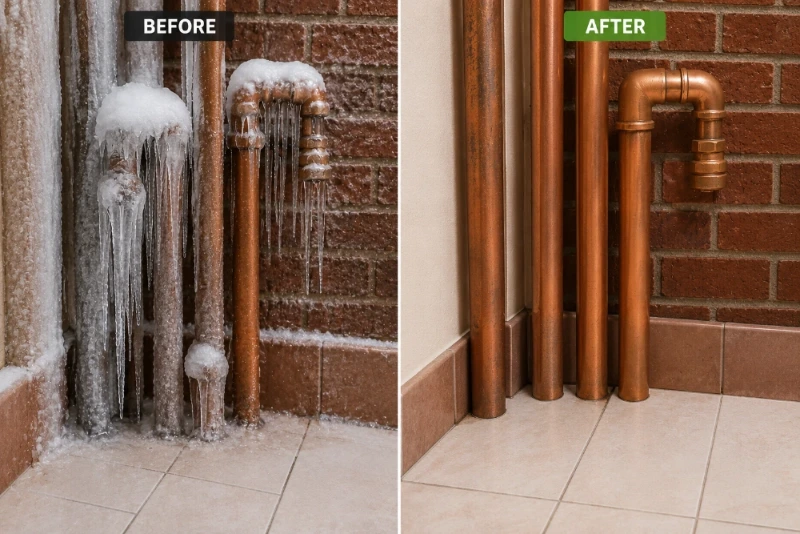
Winterize unused drains if you leave for the season. Prescott has a real seasonal-homeowner population, and the City’s own winterization guidance covers draining lines before leaving. A dry trap lets sewer gas in and lets the line crust shut; a frozen trap in an unheated space can crack and leak when it thaws — at which point you need a burst pipe repair instead of a simple drain cleaning. If you head south for the winter, have your lines properly prepped before you go.
Respect the hard water. At 4.3–7.6 grains per gallon, Prescott water is only moderately hard by the City’s official measure — but scale still accumulates year after year, roughening pipe walls so debris catches more easily. If your drains are slowing and your fixtures show mineral crust, scale is part of the story, and jetting removes it in a way cabling cannot.
What Does Drain Clearing Cost in Prescott?
Honest typical ranges for this market — and why we will not quote your job sight unseen.
Here is how drain cleaning Prescott pricing usually breaks down in our experience. A single-fixture clog cleared by cable — kitchen sink, tub, shower, or toilet — typically runs $129 to $289. A main sewer line with camera inspection and clearing typically runs $249 to $549. Hydro-jetting usually lands between $349 and $795, depending on line length and access. A camera-only inspection — diagnosis plus your copy of the footage — typically runs $99 to $149, credited toward the clearing work if we do it the same visit.
Those are typical ranges, not promises, and any company quoting your exact price over the phone is guessing — possibly low to win the call, with the real number appearing on-site. We do it the other way: camera first, you see what we see, then a flat written price you approve before any work begins. What moves a job within those ranges: cleanout access, how far down the problem sits, whether the pipe is intact or damaged, and how much buildup the camera shows. If the footage reveals a cracked or collapsed section that cleaning cannot fix, we say so — and pivot to the repair conversation on our sewer line repair page instead of charging you to clean a pipe that needs replacing. That honesty costs us jobs sometimes. We would rather lose a job than sell you one that does not work.
Service Commitments — What You Can Hold Us To
Not reviews we wrote about ourselves. Promises you can check.
Camera Before Tools, Every Time
No blind cabling, no guessing. If a tech ever reaches for the auger before the camera, you have our permission to stop the job.
Your Footage, Yours to Keep
Every inspection recording goes home with you — before you approve the work, not after. Get a second opinion with it. We encourage that.
Flat Price in Writing First
You approve the exact number before clearing begins. If the camera reveals a surprise mid-job, work stops until you approve the change.
Verified Clean, On Camera
We run the camera back through after clearing. You see the clean pipe on the monitor. Proof, not promises.
Real 24/7 Answer
Emergency drain calls reach a live person around the clock — nights, weekends, holidays. A backed-up main line cannot wait for business hours.
Cleaner Than We Found It
Shoe covers, drop cloths, and a wiped-down work area. Drain work is messy; your home should not look like it afterward.
Three Typical Scenarios We See in Prescott
Illustrative examples of common jobs — not real customers, not real addresses. Your situation will have its own camera footage.
The Prescott Valley kitchen that kept slowing down
A family in a 2000s Prescott Valley subdivision called about a kitchen sink that drained slower every month. The camera showed the line coated in grease nearly its full length — the cooler buried line had let years of cooking grease set into a narrowing sleeve. A cable would have poked a hole through it and the clog would have returned by the holidays. Hydro-jetting stripped the walls back to bare pipe, the verification camera confirmed it, and the homeowner got the grease-discipline talk: wipe pans, trash the cooled grease, run hot water after greasy washes. Typical outcome: a kitchen line that drains like new, with a re-check suggested in about 18 months.
The downtown historic home with the seasonal backup
A homeowner near the Courthouse Plaza historic district had the same main-line backup every spring and fall for two years — always “fixed” with a snake, always back. Our camera found the real story: a vitrified-clay lateral with pine roots entering at three separate joints, one nearly closed by the root mat. We cut the roots, showed the homeowner the footage of each entry point, and laid out the honest options: scheduled root cutting twice a year, or repair the entry points before a joint fully separates. They chose scheduled maintenance with a repair plan for the following spring. Typical outcome: no more surprise backups — a plan instead of a cycle.
The slow tub that was not just hair
A Prescott homeowner assumed a slow master-bath tub was a hair clog — it usually is. But the camera showed heavy mineral scale lining the galvanized branch line, roughening the walls so every bit of hair and soap caught. Cabling alone would have cleared the hair and left the scale. The fix was a cable clear followed by a targeted descaling flush, plus strainers on the tub and sink. Typical outcome: drains that stay clear because the underlying cause — years of hard-water film — was addressed, not just the symptom.
Drain Service Across Prescott & Prescott Valley
From the historic downtown laterals to the newest Prescott Valley subdivisions — and the outskirts in between.
We clear drains throughout the City of Prescott — 86301, 86303, and 86305 — including downtown and Whiskey Row, the Courthouse Plaza historic districts, Hassayampa, East and West Prescott, Fleury’s Addition, Pine Crest, Whipple Heights, Mile High Park, South and North Prescott Townsite, Yavapai Hills, Timber Ridge, Cliff Rose, the Thumb Butte area, Lynx Lake Estates, Prescott Lakes, Granville, Pronghorn Ranch, Stoneridge, and the Prescott Country Club area. We cover the Town of Prescott Valley — 86314 and 86315 — where the newer housing stock meets expansive clay soils that keep our camera busy. And we serve the surrounding communities: Chino Valley, Williamson Valley, Dewey-Humboldt, Mayer, and Spring Valley, where septic systems and well houses add their own drain quirks to every call.
Each neighborhood has a drain personality. The historic core brings clay laterals and pine roots. The hillside neighborhoods bring granite-soil ground movement and older galvanized branches. Prescott Valley brings newer PVC, clay-soil joint shifting, and heavy-cooking households with grease-packed kitchen lines. Our northern Arizona crews also run drain calls out of our Flagstaff service area, and you can browse every city we serve on our Arizona plumbing directory. Wherever you are in the greater Prescott area, the protocol is the same: camera first, flat price in writing, verified clean before we leave.
Prescott Drain Cleaning Questions, Answered
Real homeowner questions — answered precisely, the way we would answer them on your doorstep.
How much does it cost to unclog a drain in Prescott?
Do you really run a camera before clearing my drain?
Are pine or juniper roots causing my slow drains?
Should I choose cable cleaning or hydro-jetting?
Can I just pour root killer down my drain?
How often should drains be cleaned in Prescott?
My drains gurgle but nothing is fully blocked. What does that mean?
Do you offer 24/7 emergency drain cleaning in Prescott?
Slow Drain? See Inside It Before You Pay to Fix It.
Camera-first diagnosis, flat written pricing, and verified-clean proof — for drain cleaning Prescott homes can count on, day or night. Call now and talk to a real person.
Prefer to browse first? Start at our Prescott plumbing hub or explore every city we serve on our Arizona service directory.