#1 Sewer Line Repair Prescott, AZ
Backed-up drains, sewage smells, or soggy spots? We find the break, show you the camera footage, and fix it right.
24/7 emergency response · Licensed & insured · Serving Prescott 86301, 86303, 86305
What does sewer line repair actually involve in Prescott?
Your sewer lateral — the pipe from your house to the city main — runs through some of the toughest digging ground in Arizona.
Your sewer lateral — the pipe from your home to the city main — runs through some of the toughest digging ground in Arizona: 1.4-billion-year-old granite, decomposed-granite grus, and — out in Prescott Valley — pockets of expansive clay that shift with the seasons. Here, repairing it is excavation as much as plumbing. If you are comparing sewer line repair Prescott AZ options, start with the camera, not the shovel.
Every job starts with a sewer camera run from a cleanout to the city tap — recorded, with you watching. Then we talk options: spot repair, trenchless bursting, cured-in-place lining, or open-cut replacement, priced in writing before work starts. Every fixture slow at once means a main-lateral problem; one slow sink is usually a branch our drain cleaning in Prescott crew clears same-day.
Prescott’s system is a patchwork of eras: the city maintains roughly 400 miles of sewer pipe, 9,000+ manholes, and 65 lift stations feeding the Sundog plant and the Airport reclamation facility, while downtown laterals around Courthouse Plaza and Whiskey Row can be clay or cast iron laid generations ago. The outskirts — Williamson Valley, Dewey-Humboldt, parts of Chino Valley — run on septic instead (more on that below). A sewage backup and a freshwater leak are different problems: if you suspect supply-side trouble, see our Prescott leak detection page. And every dig near buried utilities is coordinated through Arizona 811 — the same caution behind our gas line repair work in Prescott.
What are the signs my sewer line is failing?
The warning signs sewer line repair Prescott homeowners call us about — catch them early and the fix is usually smaller.
Backups at the lowest fixture
Toilets or floor drains backing up again — especially after a snaking that “fixed” it for a month — point to the main lateral. Repeat backups are the number-one sign the line itself is compromised.
Gurgling drains and bubbling toilets
Air trapped behind a blockage or a sagging “belly” escapes through the nearest trap. One toilet gurgling when another flushes means the main line is struggling to breathe.
Sewage smell in the yard or house
A cracked lateral vents sewer gas where it should not. A dry trap is the easy fix; a persistent outdoor smell near the line’s path usually means a break.
A soggy patch or extra-green stripe
Leaking effluent fertilizes grass. In Prescott’s dry climate, one suspiciously lush strip tracing a straight line is a tell worth a camera look.
Every drain slow at once
One slow sink is a branch line. Every fixture slow at once is the main lateral. Our Prescott drain cleaning camera inspection tells the two apart in minutes.
Settling soil near the line
A long-term leak washes soil from around the pipe and the ground above can dip. Rare but serious — a new depression along the line’s path should not wait.
Why do downtown Prescott’s old clay laterals keep backing up?
Courthouse Plaza, Whiskey Row, and the historic districts still run on pipe laid generations ago — and tree roots know it.
Prescott was Arizona’s first territorial capital, and the neighborhoods around Courthouse Plaza and Whiskey Row — rebuilt in brick and stone after the 1900 fire — hold some of the oldest residential plumbing in the state: 700+ National Register properties and a dozen historic overlay districts. In much of that core, the original sewer laterals were vitrified clay or cast iron, and many are still in service.
Clay fails at its joints — a bell-and-spigot seam every few feet that shifts, cracks, or loses its seal over decades, while Prescott’s pines and junipers send feeder roots straight for the moisture. Once a root hair finds a joint it thickens inside and the line backs up. A cable cut buys months; the joints stay open, so roots always come back thicker.
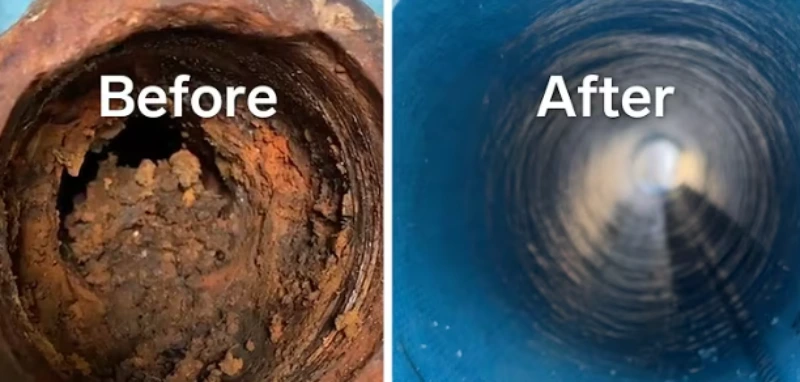
Cast iron fails from the inside: scale and corrosion narrow the bore year after year, and Prescott’s 4.3–7.6 gpg “moderately hard” city water is plenty to crust a 60-year-old lateral. On camera: orange-brown tuberculation and root masses hanging from the crown at every joint.
Ground movement opens new root paths too — monsoon runoff, irrigation changes, and settling trench backfill can offset clay joints just enough to start a decade-quiet line backing up every few months. When roots become a standing appointment, our camera-first drain inspections in Prescott settle repair-versus-replace with pictures, in under an hour.
Why does digging a sewer trench cost more in Prescott?
Nobody puts this on their website, but every excavator in Yavapai County knows it: the ground here fights back.
Prescott sits on 1.4-billion-year-old granite — the same rock as the Granite Dells — weathering into decomposed-granite “grus” gravel. Local excavators describe area “slab granite” as genuinely tough digging, and solid bedrock must be broken mechanically — slower, louder, more expensive, and unhurried around live utilities.
This is the line item that makes two sewer quotes differ by thousands. A shallow lateral in soft backfill is a day’s digging; the same trench through granite can take days of breaking, hauling, and hand-work near gas and water services. Any quote written without knowing what is under your yard is a guess — which is why we probe and camera first, and why our written price accounts for the rock.
Prescott Valley’s wrinkle is the opposite: pockets of expansive clay that swell and shrink with the seasons, shifting pipe and opening bellies that hold standing water — a permanent partial blockage, and one of the few conditions where lining just copies the sag into the new pipe.
Rock also tilts the math toward trenchless methods, which work inside the old pipe and barely disturb the ground. Every trench near utilities is coordinated through Arizona 811 with UniSource gas markings verified — the same discipline behind our Prescott gas line work.
Should I choose trenchless or open-cut sewer repair?
In granite country, fixing the pipe from the inside is often the smartest move — when your line qualifies.
Trenchless repair replaces or renews the pipe without a full trench — usually just small pits at each end. Where the yard sits on granite, that is a genuine advantage: no days of rock-breaking, no torn-up driveway. Choosing between trenchless and open-cut sewer line repair Prescott homes need comes down to what the camera shows.
Pipe bursting pulls a new HDPE pipe through the old line, fracturing it outward as it goes — the right call when the old line is too damaged to line but the path and grade are sound. You get a brand-new jointless pipe with no joints left for roots.
Cured-in-place (CIPP) lining installs a resin liner inside the old pipe and cures it into a “pipe within a pipe” — the right call for root intrusions, minor cracks, and scale in a sound line. It cannot fix lost grade: a lined belly is still a belly.
Open-cut replacement still wins sometimes: fully collapsed lines, severe bellies in shifting clay, no usable access, or a path that must change. It costs more in rock, but it corrects grade problems trenchless cannot touch.
| Method | Best for | Digging | Prescott fit |
|---|---|---|---|
| Pipe bursting | Cracked or collapsed clay/cast iron with sound grade | Two small pits | Excellent — new jointless pipe, minimal rock work |
| CIPP lining | Root intrusions, minor cracks, scale; structure intact | Usually one access point | Excellent — seals every joint roots exploit |
| Spot repair | One bad joint or short bad section, rest sound | One small excavation | Good — cheapest fix when damage is localized |
| Open-cut replacement | Collapsed line, severe bellies, grade corrections | Full trench | Necessary sometimes — budget for rock-breaking time |
The camera qualifies your line for a method — and stops oversells. If a contractor recommends full replacement without showing you footage, get a second opinion. We show every customer the video first.
How do I know if I’m on sewer or septic?
Real demand, honest boundary: inside Prescott you are almost certainly on city sewer — on the outskirts, often not.
The City of Prescott runs a real municipal system — about 400 miles of pipe, 65 lift stations, two treatment plants (Sundog and Airport, being consolidated into one). In the core neighborhoods inside 86301, 86303, and 86305, you are almost certainly connected.
But growth has outrun sewer in places: a 2020 Mayoral commission studied connecting septic users on City water to public sewer and identified twelve areas still on septic — and no official boundary map exists, so we will not draw you one. The pattern: Williamson Valley, Dewey-Humboldt, and Chino Valley’s outskirts sit largely outside city sewer, on county-jurisdiction septic.
Three quick checks: a sewer charge on your water bill means city sewer; a round concrete lid or risers in the yard with no sewer charge points to septic; your closing disclosure usually names the system.
One caution for outskirts homeowners: a “backup” on septic can mean a full tank, a crushed distribution box, or a saturated field — none of which a camera in the house lateral will fix. Know your system before anyone sells you a repair. In the core city, start with our Prescott plumbing hub.
What happens during a sewer line repair, step by step?
No mystery, no surprises: the exact sequence we follow on every Prescott sewer job.
1. Camera inspection. We run the camera from the nearest cleanout to the city tap and record the full run — you watch live. A locator marks every defect’s position and depth, so we know the problem to the foot before anything is dug.
2. 811 and permits. Arizona 811 marks utilities at least two working days out; we pull the city or county permit, and the work is inspected before backfill.
3. Access. Trenchless jobs get small pits at entry and exit; open-cut opens the marked trench, breaking rock mechanically and hand-digging within two feet of any marked utility. No exceptions.
4. The repair. Bursting, lining, spot repair, or replacement — whichever the camera qualified. New pipe to code: bedding, grade, and solid connections.
5. Inspection and testing. The inspector signs off; we run the camera back through so you see the finished, jointless line.
6. Backfill and restoration. Compacted lifts so the trench does not settle into a ditch by monsoon season; spoils hauled, surfaces restored.
Do I really need to call 811 before sewer work in Arizona?
Yes — it is free, it is required before you dig, and in Prescott it keeps the backhoe away from the gas line.
Arizona 811 — Arizona Blue Stake — is the free call-before-you-dig service, required before excavation. Call at least two working days ahead: UniSource marks gas, the city marks water and sewer, plus electric and telecom. Anything within two feet of a mark is hand-dug. Skip it and you are gambling with a gas line.
The gap homeowners miss: 811 marks utility-owned lines only, up to the meter. Irrigation, landscape lighting, propane yard lines, and your house-side water line are not marked — hitting them is on the digger. We walk every site with you first and ask what only you would know is buried.
Most lateral repairs also need a city or county permit, with inspection before backfill verifying depth, bedding, grade, and connections — Yavapai County standards call for 12 inches minimum sewer cover. The permit record follows the house at resale. We pull permits and call 811 on every job; it is process, not upsell.
What does sewer line repair cost in Prescott?
An honest answer, not a teaser rate: the ground moves the number more than anything else.
So what does sewer line repair Prescott work actually cost? The ground moves the number most: length, depth, access, permits, and restoration all matter, but a trench through soft backfill and one through slab granite are different jobs — and any quote ignoring the ground will grow.
Typical industry ranges, broad on purpose: a camera inspection is a flat quoted-up-front visit — you keep the footage either way. Spot repairs on a short bad section typically land in the low thousands. Trenchless bursting or lining of a full lateral typically lands mid-four-figures to low-five-figures by length and access. Open-cut in Prescott granite runs higher still — rock-breaking bills in days, not hours.
Two written promises. First: no sight-unseen ranges presented as your price — anyone pricing your line over the phone is selling a number they will revise. Second: one fixed written price after inspection — method, the footage justifying it, permits, restoration, one number. And if the camera shows the trouble is in a branch line rather than the lateral, the fix usually falls to our drain cleaning side at a fraction of the cost — one more reason the inspection comes first.
Our service commitments
Not testimonials — the standards we hold ourselves to on every sewer job.
Camera first, always
We show you the inside of your line before recommending anything. If the footage does not justify the repair, we say so.
Fixed written price
One number in writing before work starts — method, permits, inspection, rock contingency, restoration. No mid-job surprises.
811 on every dig
Arizona Blue Stake called at least two working days before excavation, UniSource gas markings verified on site. No exceptions.
Permitted and inspected
We pull the permit and the work is inspected before backfill — code-compliant and documented for resale.
Yard left right
Trenches backfilled in compacted lifts, spoils hauled, surfaces restored. Granite country makes a mess — we clean up ours.
We answer, day and night
Sewage backing up at 2 AM is an emergency. Our line is answered around the clock; true backups get same-day response.
What do typical Prescott sewer jobs look like?
Representative scenarios from the Prescott plumbing work we see — not real customers, but real patterns.
A 1920s home near Courthouse Plaza
Original clay lateral, roots at nearly every joint, cabled three times in two years. The clay between joints still held shape — a textbook CIPP lining candidate: one access pit, liner cured in a day, every joint sealed, no trench across a century-old yard.
Why it worked: sound grade and structure meant sealing the joints beat replacing a pipe that did not need replacing.
A 2000s Prescott Valley home, every fixture slow
No roots, no collapse — just a long belly in expansive clay holding standing water. Lining would have copied the sag into the new pipe, so we trenched one section, corrected the grade with proper bedding, and reconnected.
Why it worked: the camera ruled trenchless out instead of selling it anyway.
A ranch home on a granite ledge, collapsed cast iron
Cast iron scaled shut, then collapsed under the driveway — open-cut meant days of rock-breaking to six feet. Path and grade were good, so we pipe-burst new jointless HDPE from two small pits: driveway intact, granite undisturbed.
Why it worked: bursting made the hardest digging ground a non-issue by never digging through it.
Where we handle sewer line repair
City sewer in the core, honest answers on the outskirts.
We serve Prescott’s city-sewer neighborhoods across 86301, 86303, 86305 — downtown, Whiskey Row, Courthouse Plaza, the historic districts, and the established subdivisions — plus Prescott Valley (86314, 86315), where newer lines meet expansive clay.
On the outskirts — Williamson Valley, Dewey-Humboldt, Chino Valley — many homes are on septic. We will still take your call, help identify your system, and refer septic tank or drain-field issues to a specialist rather than sell you a sewer repair you do not need.
Start from our Prescott plumbing hub for everything we do in town, browse our Arizona service areas for the full statewide footprint, or — if you are up north — see our Flagstaff plumbing services.
Sewer line questions, answered precisely
The questions Prescott homeowners actually ask — answered the way we answer them on the phone.
How much does sewer line repair cost in Prescott?
Most Prescott sewer jobs land in the low-to-mid thousands with trenchless on the table; open-cut in granite runs higher. No plumber can price your line unseen — length, depth, rock, and access move the number most. We camera first, then give one fixed written price. Call (866) 471-4088 for an honest quote after inspection, never a sight-unseen range.
Do you use trenchless technology to repair sewer lines in Prescott?
Yes — pipe bursting and cured-in-place (CIPP) lining both work here, sparing your driveway and landscaping. Trenchless fits when the old line’s path is sound with access at both ends — not for fully collapsed lines, severe bellies in shifting clay, or lines with no usable access. The camera decides, and we show you the footage first.
Can tree roots really break a sewer line?
Roots rarely ‘break’ a healthy new line — they invade. They find the joints in old clay and cast-iron laterals — the kind still common in Prescott’s historic districts — and work in through tiny gaps. Inside, the mass catches everything and backups repeat. Cutting buys time but joints stay open, so regrowth is near-guaranteed. The permanent fixes are trenchless lining or replacement. If drains keep clogging after snaking, ask about our drain cleaning camera inspections.
How do I know if I need a repair or a full replacement?
One bad joint in a sound line is a repair; multiple offsets, heavy intrusion, crumbling clay, or a repeatedly patched line is a replacement. The camera decides: we measure damaged length, count defects, check material. Rough rule: if more than a third of the run is failing, replacement usually costs less over ten years than repeated spot repairs.
How long does a sewer line repair take in Prescott?
Most trenchless jobs finish in one to two days; open-cut typically takes two to four. Granite trenching is the wildcard — rock-breaking time cannot be predicted until the trench is open. Permitted jobs add a day for inspection and backfill. Backups get cleared the same day you call.
Will trenchless sewer repair work in Prescott’s rocky soil?
Usually, yes — that is why trenchless is popular here. Bursting and lining happen inside the old pipe, so surrounding granite barely matters; rock only punishes open-cut digging. Exceptions: a fully collapsed section the bursting head cannot pass, and severe bellies in Prescott Valley’s expansive clay. The camera rules both out.
Am I on city sewer or septic? How do I tell?
Core Prescott neighborhoods are almost certainly city sewer — about 400 miles of city pipe feed the Sundog and Airport plants. The outskirts — Williamson Valley, Dewey-Humboldt, parts of Chino Valley — are typically septic: a sewer charge on your water bill means sewer; a yard lid or risers with no sewer charge means septic. Septic tank or drain-field problem? We will say so and refer you to a septic specialist — we do sewer lines, not septic systems.
Do I need a permit or an 811 locate before sewer work in Prescott?
Locate: yes. Permit: usually. Arizona 811 (Blue Stake) is free and required before digging — call at least two working days ahead so utilities mark their lines. Most lateral repairs also need a city or county permit with inspection before backfill. We pull the permits and call 811 on every job.
Sewer trouble? Don’t wait for the next backup.
Call now for sewer line repair Prescott can count on — camera diagnosis, honest options, fixed written price.
24/7 emergency response · Licensed & insured